Showing posts with label ruminating. Show all posts

Saturday, October 26, 2013

Castle, "Time Will Tell": Tell what, exactly?


Right. Well... That was weird.

I'll admit that I'm kind of at a loss as to what to think about this episode. It's not that I didn't enjoy it. It's just that I didn't get it. Castle has occasionally toed the line separating the general run-of-the-mill non-reality (e.g. Beckett's wardrobe and Tribeca apartment on her salary, Castle's Soho flat, how the 12th looks and is run, the feds' equipment, etc.) from the more totally bizarre, bombastic, ridiculous non-reality (I usually think of "Close Encounters" and the abduction by the feds, because, I mean, come on, what was that (even if it was totally hilarious)?). But "Time Will Tell" pretty much blew everything out of the water, to the point where there were times when I seriously questioning what show I was watching. I felt like I was spending half the episode waiting for Mulder or Buffy to show up, like there was a possibility that at any moment an interdimensional portal was going to open up in the middle of the bullpin or a couple black helicopters were going to descend upon the roof as the voice of Cecile Baldwin started rambling about the Glow Cloud. It was just completely bizarre, and as much as I could've accepted it, by the end the show seemed to really, really want you to believe that Simon Doyle wasn't a nutball. And that...that's just weird to me.

Castle isn't a sci fi show. It's a cop show. Sometimes it's a silly cop show, sometimes it's wildly ridiculous, sometimes it homages and pushes to the very edge of believability, but it's still a cop show. It's not The X-Files. Yet, this week... we went X-Files. In a lot of ways. I mean, come on...
Is-- Is that... Oh my god. It's Ed Jerse.
It's Eddie. Fucking. Jerse.
This is an episode with both David Amann and Rob Bowman in the credits (Bowman who, coincidentally, also directed Never Again), which on its own isn't a particularly special fact, given they've been involved since s1. But the addition of Rodney Rowland (Ed Jerse, AKA the crazy guy with the Jodie Foster tattoo who once tried to throw Scully into an incinerator) and the crazy, sci-fi nature of this plot makes me look at them suspiciously (even if it was written by Marlowe and Terri Edda Miller). And then there's this:
Oh, good god, Beckett. I know the shoulder pads started showing up last year with that crazy black blazer (which I'm pretty certain is the same blazer you wore this episode on day 2), but, come on. Those things are beyond quarterback levels. They're as intense as mid-90s Scully shoulder pads (and to be frank, I didn't think there was anything more horrifying in this world than mid-90s Scully shoulder pads, which always seemed to be the worst in those awful creme suits she seemed to love s2/3). She even has her pants pulled up high just the way they used to do it back in the 90s. I mean, honestly, Beckett. Half of the reason I first got into this show is because you're the best vehicle for coat porn I have ever seen in my life (something I still appreciate to this day), but this week... Good, sweet, baby Jesus...
I mean, look at those things. It's like she's wearing a jet pack.
I'm pretty sure this is the same blazer she wore to her interview in "Watershed" and a few other times ("Recoil" I remember, off the top of my head), though I'm too lazy to check to confirm. For whatever reason it wasn't so glaringly hideous before, but I think that's because this week it followed that white monstrosity.
This isn't exactly substantive commentary, but I can't help myself. This combined with Jerse and the plotline really made me feel like I was watching another X-Files homage episode, just without the direct references. Even the abandoned industrial plant place looked a lot like the set used in "War of the Coprophages." What I can't figure is if all this was intentional or not. It certainly feels like it was, but even if I'm right, and it was, I'm not sure that that really absolves it-- mostly because the episode ends with the heavy suggestion that Doyle really is a time traveler.

And there are a lot of reasons I'm unhappy about that.

The first is obvious. I don't tune into Castle for sci fi, and I feel like it's reasonable to expect that the show never go there. It breaks suspension of disbelief into a thousand jagged pieces to suddenly and randomly be thrown into a different genre. Castle's dealt with the supernatural before, but by wrapping time we're always given a rational explanation for everything, with at most one or two loose threads that tickle us with a playful little suggestion that maybe there is something para about the normal. "Scared to Death" was one of my favorite episodes of s5, as was "Demons" in s4. I love Scully-Beckett, and I really, really love (faux)Mulder-Castle, purposely ribbing Beckett whenever he can for the sake of personal amusement. But episodes like those never forgot that the show is, at heart, a procedural cop show (and "Close Encounters" didn't forget either). "Time Will Tell" did forget. It forgot hard. I don't know if this is a fault of editing or pacing, but even on the second watch I found myself being pushed into believing that Doyle was telling the truth. Never for a second did "Demons" or "Close Encounters" really leave me with that kind of impression. The fact that the episode then ends with him randomly disappearing, leaving his doo-hicky with Castle, and with Beckett creating the stain on that paper... that was just X-Files level of weird. That's actually precisely the sort of thing that XF would've done. The "rational explanation" felt more footnote-y than anything, shoved in there for about three seconds at the end.

And all of this I could sort of accept, except for what this episode is so heavily implying by having it end this way.
Me too, Beckett, though for different reasons.
When it comes down to it, there's one thing that terrifies me above all else whenever I start watching a show and find myself really loving the female lead. And that is the possibility that she is going to get pregnant.

I just... I can't handle it. I hate the idea that a woman cannot just end her story without children. And as petty as it is, I hate it when actresses get pregnant during filming, thus almost inevitably causing her character to also become pregnant. I thanked every god on Olympus, every god everywhere that has ever been conceived when Jill Hennessy's pregnancy only resulted in strategic coat and table placement in s3 of Crossing Jordan, and that Jordan was able to close the show having escaped the fate of becoming pregnant. This is something that Bones' Temperance Brennan did not escape (despite her s1 statement that she doesn't want children and has no intention of having any). This is something that Mary Shannon of In Plain Sight did not escape. This is something that Sydney Bristow of Alias did not escape (to my infinite displeasure, since as ridiculous as that show was I still sort of loved it). Dana Scully couldn't even escape it, despite her canon infertility. The idea of Beckett becoming pregnant with Castle's spawn is so horrifying to me that it honestly makes me feel slightly nauseous.

And "Time Will Tell" is almost blatantly stating, "Yeah, she's totally getting pregnant."

I had been entertaining the nightmare ever since the Caskett became a thing that Beckett was going to get pregnant. When we got through s5 without it ever coming up for even half a second, I heaved a huge sigh of relief. But this episode... between Castle's relaying his want to relive Alexis' childhood and Doyle's predictions, I'm really starting to feel that we're going to close s6 with a positive pregnancy result.

This is literally the worst possible thing that could happen. No matter how much I've invested (and I've invested a lot into the show right now), if it happens, that's it: I'm done. I'm done immediately, no question. I stopped watching IPS and Alias literally the second the pregnancies were revealed.

The problem with "Time Will Tell" in this context is then... everything. The name is suggestive ("only time will tell if Doyle was correct"). The ending is suggestive ("guys, he really is from the future, and he knows that they have three children"). The dialogue is suggestive ("our future" from Beckett, Castle clearly wanting to spend time with tiny!Alexis again, and the later "drive you crazy" comment). It's such blatant fan-service for Caskett fannits who would inevitably support this sort of thing that it makes me feel like I should start lowering the lifeboat off the ship and piling in the life jackets.

The thing is that I don't want to jump ship. I want to keep enjoying Castle until it ends. I want to keep enjoying Beckett, keep enjoying her badassery, keep enjoying how quickly she draws her gun, that look on her face when she leads the way into a hostage scene or a dangerous scenario, when she glares down some dirtbag in the box like she's an attack dog sitting poised at the end of a short length of chain, and I want to keep enjoying casual!Beckett with her flowy clothes and easy smile. A pregnancy won't change Castle much, if it all (he's already a father), but it will change Beckett. It will change her a lot. A lot a lot. And I don't watch Castle for children and family drama, and I certainly don't watch it to see Beckett getting increasingly chained to her desk because of her (unsightly) physical impediment. I don't want to see her angsting about how a pregnancy and a kid is going to affect her life (considering, a) she's a confirmed workaholic, and b) she loves her job), I don't want to see some cutesy dialogue between her and Castle about her having to give up coffee until she has the kid, and I really, really, really, really do not want to see her in any stage of pregnancy, birth, or baby-holding.
Ugh, just shoot me, Beckett.
The reality is, she's a woman living the 21st century. She's extremely independent, a hard worker, embroiled in a dangerous career, with her life hanging precariously on a bluff she made against a man who could easily order her death once he realizes what she did. And she's in a relationship with a man who already has a daughter. A 19 year-old daughter. She doesn't need to have a kid to be fulfilled as a character, and, frankly, the idea of the two of them producing spawn that's a full twenty years younger than Alexis is just disturbing. If Alexis has children, they'll be of comparable age to her own siblings. And Castle would end up being like sixty by the time these kids entered high school (and Beckett may end up just being dead-- becoming, with a brutal irony, her mother to her children (murdered as Jo was)).

"Time Will Tell" is the first episode that's seriously suggested that Beckett is going to be subjected to this shit. What's worse is that it was co-written by the creator of the show (Marlowe). Am I being alarmist in reading into this? Maybe, but I can't help myself, especially since Beckett didn't say anything against the idea of having children. And it's because of this that this episode put the fear of god into me.

As for the rest of the episode, it was entertaining (up until Doyle made his predictions, at which point my brain pretty much melted). I didn't have that strong of a reaction to Alexis wanting to move in with Pi. The thing about Alexis is she's always pretty much done what she wants, just like her father, and I've justified in my head-canon why she's in a relationship with Pi: I think part of her likes his dependence on her, especially since her other canonical boyfriends all left her (from what I can remember; I mean, she broke up with Ashley, but he physically and emotionally left her long before that); I think she likes how casual and non-serious he is, especially in light of the fact that she's such an extreme academic fuddy duddy, because I think she probably finds it comforting (I can totally see her being one of those college students who's starting to fear what she's actually going to do with her life once she graduates); I think it's possible that she's too naive to see that part of what's motivating him to be with her (I'm guessing) is her money. Moving in with him may not be the brightest move on her part, but it's not like she's marrying him (merging assets), and I'm really, really confident that if they two of them have started boinking, she's practicing safe sex. Once things go wrong, I can see it being an ugly break-up, sure, probably even a messy one, what with them living together, but not permanently damaging-- either emotionally, financially, or physically (since Pi doesn't exactly strike me as violent). Do I like the fact that she fought with Castle? No. But, then again, this is hardly the first time they've clashed over her decisions regarding her relationships (I have a feeling that she may have internalized Castle always telling her that she's "the smart one" -- to the point where she believes that she truly is better at making decisions than him). I'm sure in a few episodes she'll show up in tears on Castle's doorstep telling him what a mistake she's made, apologizing for acting rashly and impulsively, for not listening, and everything will be fine. I mean, for god's sake, Castle is rich enough to buy any attorney in the nation, and his fiance is a cop. If there's anyone who could get out of a messy relationship with very little real blowback, it's someone with Alexis' resources.

At any rate, that's pretty much all I have to say. To be frank, I just really, really hope "Time Will Tell" was nothing more than tease, because I'd love to rewatch it ten episodes or a season from now and laugh at how ridiculous my reaction was to it, since it was otherwise a hilarious episode on the face of it (I mean, come on, the only thing more annoying than ghosts or demons or Big Foot or aliens or the CIA would have to be time travelers when it comes to working with Castle on a case, especially if a lot of the evidence piling up is only supporting Castle's whimsy when all she truly wants is to find the living, breathing, skin-and-bone explanation for everything so she can close the case and go home and take a bath and go to bed). Joshua Gomez' (Doyle) performance was a lot of fun to watch. I loved watching Beckett getting tackled like a quarterback (to match the shoulder pads), finally dragging herself up from her daze with gun and temper raised high. I'm finding it amusing that this is the fourth time Castle has almost died in as many episodes (since, again, I consider 6.01 and 6.02 to be one episode canonically). I'm wondering what happened to Gates and Sully, but to be honest it doesn't bother me that much that Beckett got her desk back and hasn't been relegated to a new place. Overall, it was good, fun, solid.

It's just... yeah. You get it, you know what I'm concerned about. I just hope I'm wrong, overblowing the whole thing because I'm on high alert.
Please just shoot Bracken in the face before something worse has the chance of happening.
At least give me the pleasure of watching you pull that trigger if things are truly going to go the way I fear.
And then you can go ahead and shoot me too.

Friday, October 11, 2013

Castle, "Need to Know": Because things fall apart


Oh, "Need to Know." So many feelings. So many, many feelings. So many I'm not entirely sure where to start.

I guess my first jumping off point is the speculation that this was an episode written to give Stana Katic less screen time for whatever reason. She was in very little of the episode, which is actually a first for her as far as I can remember ("Hunt" as possible exception?), since she absorbed lead capacity back in s2 despite NF's continued first billing. Because of this I'll admit that as funny as I found the episode, there were definitely times where I couldn't help but pine for her back, and afterwards I couldn't help but reconstruct the episode mentally to try to fill in what she had been doing while the boys had been off doing their things. It's not to say I didn't enjoy the episode, but I think I might as well restate for the record that I construct Castle around Beckett, so the vast majority of my fanwanking and meta and thoughts are tied to her, not Castle. (and I only point that out because this meta is, once again, going to largely be centered around her)

Let's start with my brief, more shallow comments. Starting with the obvious:
Oh, sweet, baby Jesus
I'm sorry. This guy is just endlessly hilarious to me. The thought of him having put down stakes in Castle's living room, the thought of him endlessly rambling to Alexis about his dreams of hitchhiking across the States with nothing but a smile and an upraised thumb, the thought of him having some highly garbled concept of spirituality that no doubt blends the sensibilities of a 70s stoner with a Westernized brand of Hinduism-- everything just makes me laugh. I can see the uber pragmatic, highly academic, stuffy Alexis finding comfort in the airy ramblings of Pi and his vague promises of an uncomplicated future, as he lies back and proclaims something to the effect of hakuna matata to the ceiling (it means no worries, for the rest of your dayyyyys). The fact that Martha seems to view him as some amusing but temporary fixture in the house is funny enough, but add tousle-haired Castle driven from bed by a juicer at what I can only assume is 7:23AM and that's it. I was roaring, near crying into my pillow as random possible scenarios involving Castle and Pi or, better, Beckett and Pi (because part of me is convinced she dated a guy just like this back in the mid-90s) flashed through my mind.

Whoever conceptualized and cast this guy, thank you. I just hope you weren't responsible for the first of my complaints:
Er... Morning, Professor Trelawney
What was up with this chick? The last time I saw overacting as painful as this performance was on Once Upon a Time, which on multiple occasions drove me to cleaning my kitchen just so I didn't have to look fully at the screen. 2013!Trelawney (because that's all I could think when I looked at her) was just miserably bad, made all the worse by the awful anti-90s at her back. And while we're on the subject...
90s failed conception versus actual 90s
As a child of the 90s, I can't help but find it bizarre how far afield Castle fell in portraying the 90s. The time frame they were shooting for was less than twenty years ago, and I feel pretty confident in guessing that there are few, if any, people working on set who didn't live through it. The 90s was overalls and wrinkled overshirts, logo'd t-shirts and jeans up to the waist. Everything was three sizes too big, striped or tie-dyed or animal print. The 90s was chokers and spandex and hair clips and fuzzy sweaters and weird make-up and shaggy hair and leather jackets and leather everything. I mean, all anyone had to do was flip on a Buffy rerun circa 1997 to get wardrobe ideas, and a quick run to a Goodwill easily could've fulfilled the need.

I guess in the larger frame of things, it's not that important, but seeing the suspender-clad, clearly modern (and clearly un90s) hipsters in a 16:9 aspect ratio filled me with a lot of strange, unexplainable feelings. Why write about a mid-90s show that holds nostalgia for several characters (Ryan and Martha, at the least) without also allowing the viewers the same pleasure? Castle in the past has been very good at call-backs and references; probably one of its more shining moments was (at least in my eyes) "Close Encounters...", which brought back for me a hundred feelings from The X-Files. Yet here the best they came up with is the pathetic "2 Cool for School," reminding me rather unpleasantly of the 80s attempts at the 50s in a long series of terrible movies. Maybe this is just one of those inevitable pitfalls of the media, which seems to have the attention span and memory retention of a squirrel on meth, but it just made me suddenly fear the days we'll be inundated with "90s" films that feel about as authentic as Dewey's orange suspenders.

At any rate, let's move on to what I actually want to talk about: Beckett.
While I'm on this picture, what's up with all the wide angles in this episode? The amount of fish eye in shots like this one (and I can think of a few others, such as Esposito's confrontation of Castle in the break room and some shots in the Brooklyn warehouse) are pretty jarring. I don't know if it was intentional by the director (if there was some underlying metaphor I wasn't really getting), or what, but it was really disorienting.
What I found most interesting about this episode is how very not funny it gets once you switch POV characters (from Castle, who drives the episode, to Beckett, who sidelines), which is precisely what I did. I was struck immediately by Beckett's isolation, by the giant hole she'd left in the precinct, and by the fact that on her return she's unable to fill that space again. During that initial crime scene scene, I couldn't help being struck by how male everything is without her, and how noticeable her absence is (made even more obvious by Lanie's absence, with Perlmutter there in her stead -- I have a feeling this was intentional). It feels wrong to be at that crime scene without her. It was interesting to me to watch a random episode from a different season after that, because it's so clear how much Beckett utterly dominates the spaces she occupies. Crime scenes feel like her crime scenes. Her corner of the precinct feels utterly hers, and hers alone. It was jarring to be at a crime scene with Castle but without Beckett. No one was commanding or directing the flow. It was like they were all waiting around for her to show up and tell them what to do.

This is of course followed up by our return to the precinct, where my heart was promptly shredded upon seeing the corruption and defilement of Beckett's space.
Sidenote, did Beckett gift the ever absent Dt. Wallis one of her elephants?
It was like walking through a house I used to live in. The most important things are the same (the desk, the chair, the phones, the location), but all the details are wrong. I immediately was reminded of Spender and Fowley's take over of the basement office. I mean, all of this was clearly intentional -- Sully seems to have been cast specifically because of his not-Beckett-ness, and his desk hygiene would never be tolerated in a real work space, especially given anyone going to see Gates in her office would inevitably be walking by it -- but that doesn't change how I feel about it. I winced with Castle every time I saw it, thinking back to a hundred scenes that had taken place on that desk, to scenes I had written there in fic or conceptualized in random thoughts. The fact that Beckett at the end of the episode relinquishes her territory to him seems to make it worse somehow, like she is personally shoveling the last bit of dirt over her past life in the precinct and has every intention of moving on (which, in the context of the last minute of the episode, brings to the surface a lot of implications; I'll be addressing those momentarily).

When Beckett finally does arrive, there's an overwhelming sense of separateness. We see her through the slats in the breakroom, where Esposito is murmuring accusations of Judas-ism, we see her running giddy to meet Castle at the breakroom because someone there actually wants to see her, we see her sidling up to the whiteboard with coffee mug in hand, wanting to get in on the conversation, but immediately frozen out of it (then utterly abandoned there after McCord approaches).
I love this one in particular; it's like she's hiding in the break room
There's a real feeling like she truly has moved on, like this place is no longer quite what it was for her. There's this real sense of camaraderie between her and McCord, like they're the new unit.
While I'm on this picture, it was really interesting to see Gates coming to the defense of her people against the judging forces of the Other (McCord and, to a lesser degree, Beckett), and it was interesting to see Beckett's silence as she leans against the table, torn between old loyalties and new (especially since she was the cause of the problem)
I became fascinated by the constant mirroring between them, like to some degree they're the same person. In most of their scenes, they were able to immediately make a space feel like it was theirs alone, no matter how many other people were in the room. It's not just that both actresses have powerful screen presence; it's the fact that they would constantly turn to each other and away from other people (physically turn toward each other, not just look), that they'd often mirror each other physically. Within the span of three episodes, I completely bought them as partners. Beckett and McCord are what I wish Rizzoli and Isles (Jane and Maura) would be.

And, then you know, this happened...
Bu- but... my head canon, my plans.... Mc- McCord! NOOOOOOOOOO!
Oh, god, why. I mean, we all knew Beckett's appointment with the feds would be a temporary one, but I hadn't expected it to be dropped this quickly. Given the first two episodes were a TBC (and, thus, were one episode to me), we've only really gotten two episodes of Special Agent Beckett, and I feel robbed. I fucking love McCord, and I love Beckett's energy around her, and I'd been hoping to go at least another two or three episodes before things fell apart.

And then there's just how abruptly things fell apart. Beckett does a small leak, is immediately found out, is immediately fired. It all happens in like three minutes, so quickly I barely had time to figure out what was going on before it was done. I'm hoping next episode we see some back-tracking and explanation, because this plot-line right now ended so quickly it was like we were cruising at 70 mph and slammed into a pole (part of me feels like it was thrown in at the end without it really being planned; there's just so little warning). There's no build up, no realization scene by McCord, no discussion between Beckett and McCord about it. All of this leads me to strongly suspect that the writers regret ever having started down this plot, that they wanted to drop it as quickly as physically possible, and they jumped onto the first possible train out to accomplish this. It really makes me believe that the writers didn't have an over-arching plan for Beckett's time in DC (even more so than I already did), and I can't stop the disappointment. I knew it was going to end, and I do want Beckett to rejoin her family, but I didn't want it to happen this quickly, especially because now we're going to end up in that squicky situation of Beckett somehow magically getting her job with the 12th back again, which I know is going to be an annoying plotline and I was hoping to have it put off for a few more episodes.

I mean, overall, I really did enjoy the episode. Castle and the boys were hilarious (Ryan's matter-of-fact wearing of the crew hat was great); the Beckett/McCord, Beckett/Castle dynamic were extremely entertaining ("Are you bribing me with a latte?"); I love Beckett struggling with her isolation and her growing concern that she's being corrupted by her new job; I love Castle taking my words from last year out of my mouth by admitting he could work from anywhere so why not just live in DC with her. Were it not for the last twenty seconds of the episode, I would've loved it.

But, unfortunately, those twenty seconds did happen. So now I guess I'll have to sit and wait for Monday to see the fallout.
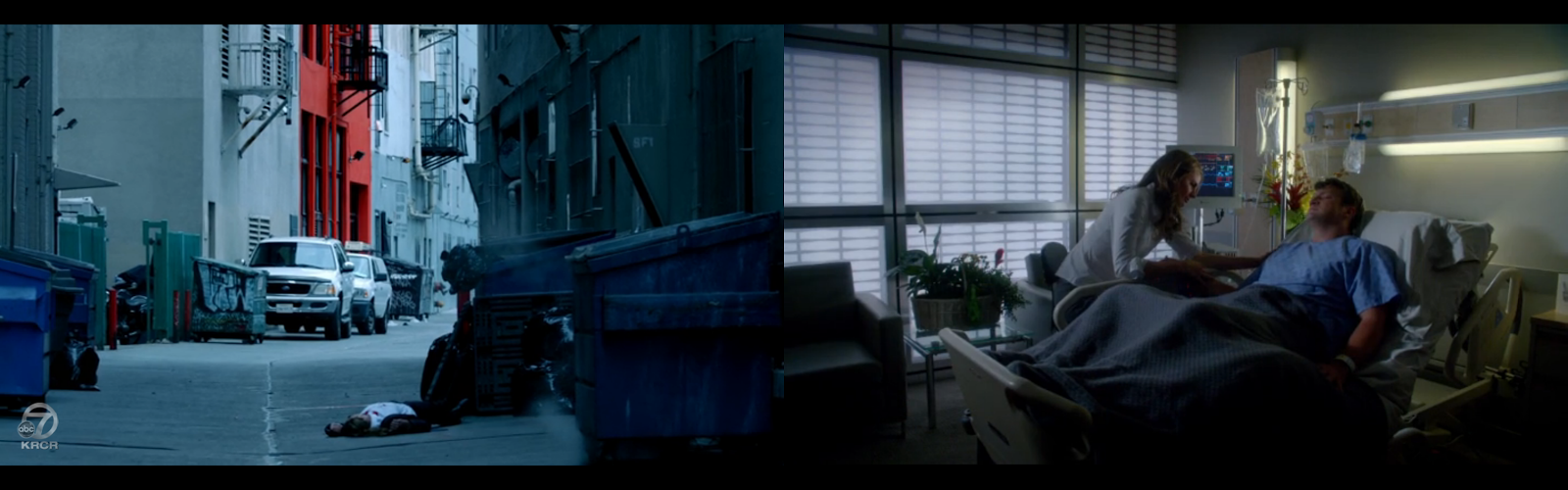
While you're in New York, Beckett, I know we've been here before, but...
You could make a little side trip.
Go over to Albany or wherever. Check out the scenery, go to a park, shoot Bracken in the face.
Come on, Beckett, I'm just gonna keep pushing this until your mytharc resurfaces.

Saturday, October 5, 2013

Castle, "Dreamworld": In the land of blue lights and green, green trees


And so we hit week two of "Everything is Going a Lot Better Than I Had Originally Projected," to my pleasure. Can everything still go horribly wrong? Of course it can, and I am suitably braced, but right now I'm feeling pretty good. Why? Well, that's what this post is for (besides personal indulgence).

So, Dreamworld. I'll just get it out of the way: yes, cheesy plot is cheesy as hell, but I have never been one to complain about contrivance -- the reality is, everything's been done already, and any correlation between quality and predictability is spurious at best. Yes, we all know going in that Castle is going to be fine, just as we all know that this engagement with the AG (or the FBI? to be honest, Beckett's job description is pretty vague) is temporary. I know I couldn't help muttering aloud to Castle at least once during initial viewing, "Don't worry, Castle, you've plot armor. Denser than lead." But that doesn't matter for the same reason that everyone knowing the resolution to "Knockout" long before it came doesn't matter, for the same reason we can watch a MOTW for years on end despite the knowledge that 99.7% of the time the murderer will be caught at episode close: because the journey's all that really matters. And I liked Dreamworld's journey.

For starters, I like the world of the AG/FBI that the show is building. I had fully expected that the office would be a cold, bloodless hell, that the people working there would be awful, distant, unrelatable, and unkind. I had expected to see Beckett trapped in the prison she'd unknowingly fallen into, homesick and pining for family. Yet that hasn't happened at all. The only thing that's really matched expectations is that the place is as gloriously ridiculous as I had imagined, with its massive touch-screen and the beeping computers and the hundreds of random, glowing blue lights (but, hey, it's TV, and Castle on top of it). But besides that, the people working there are perfectly personable, and Beckett herself seems comfortable there, at least professionally. What's more, her partner is likeable.

Let's talk about McCord for a second here, since she was a big part of my takeaway.
I like her a lot, for a variety of reasons, few of which I touched on my discussion of "Valkyrie." She's integrated well with Beckett, they seem to respect each other, and I'm getting sadder all the time that their relationship is going to end up coming to a close, since I can really see this growing into something. What did I like? Well, I liked that it was McCord who instigated the first meeting with Reed, not Beckett. I had fully expected it to be Beckett leading the charge against the Defense Secretary (given, well, she's Beckett), yet it was McCord who actively took the first strike ("Where are we headed?" "To talk to the one person who might actually know what's going on..."). I like that she already knows Beckett well enough that she's able to take the hint to leave just from the look on her face (see: 12:23). I like that she doesn't interfere with, protest against, or otherwise work against Richmond's illegal dump-mining. I like that she was given a scene in which she (attempts to) comfort Castle. I like that she trusted Beckett's hunch about Reed's wife despite not knowing her "play," that she ended up saving Beckett's life (probably). I like her "That's what partners do."
She's even giving Beckett coffee, because partners don't just back plays and save each other's lives, they do small stuff like this.
Given the show's love of contrast, I had fully expected Beckett's federal partner to be cold, indifferent, arrogant, unapproachable, and I had fully expected Beckett to hate him (because I had definitely expected a him). Yet McCord is very quickly being built into a sympathetic character -- someone similar to Beckett, just older and more cynical about the world. Part of me is already building head-canon for her: she'd been partner-less for awhile (perhaps because her last one transferred to another department or retired or died, but that was several years ago); she grew up locally, though she doesn't speak to her mother anymore (who moved to Charlotte); her dad's dead; she smoked for ten years but quit sometime in the mid-90s shortly after ending a mutually destructive relationship with a lawyer she met at a bar where a lot of government-types closed their evenings. She's fun, is what I'm getting at. And the fact that she likes and gets Beckett is a huge plus for me. I couldn't help but cheer a little at seeing that McCord has apparently already realized Beckett's coffee addiction.

I also like that Villante (the chief) is being built in a similar, likeable fashion. He seems to already respect Beckett, and he hasn't taken it upon himself to be a thorn up her ass. There's no reprimand from on high for her push to have Richmond illegally data mine from the military (which just surprised me even more than McCord not ratting about it), and he watches the clearly illegally-obtained footage/audio without comment. When he confronts Beckett about her run-in with Reed, he very quickly moves to complimenting her once he sees her plan. No threats, no leash pulling. He's even nice to Castle (not only granting him amnesty and haven within the office, but asking him to find a place in his next book for a "dashing Colombian-American federal agent"). In two episodes, Villante has reached the place that took Gates half a season to reach (if she's even reached it yet). I can actually see Beckett eventually building a relationship with him, which isn't something I feel could ever be achieved with Gates (one could make the two lionesses in one den argument, and I could go with it, but that would take too long and we're talking about "Dreamworld," not Gates). He's not Montgomery (of "Knockout" or before), probably never would be to her, but I can see them sharing a beer or something, eventually.

Also, I mean, come on:
Richmond is just hilarious. Yes, his presence borders on the painfully stereotypical, but there's something vaguely enamoring about the techie who only seems to ever move the six yards between a few different computers. It's true, he's no Marshall Flinkman, but I like that even despite how limited his screen presence has been, he's still willing to bend the rules for Beckett -- a woman he's known barely two months. He's even the one to suggest bending the rules/breaking the law. I've gotta give the guy some credit.

Overall I've just been really pleased with how overwhelmingly positive the job has been. I can see Beckett being dissatisfied with it on some level, since despite the big step up in her own power, she's no more able to take down powerful people than she was in New York (RE: Bracken), but I'm surprised at how well she's integrated, how nice everyone is being. If I didn't know better, I could see the show staying here, and I could see Beckett being okay for it, especially since for once she seems to be around equals (don't get me wrong, I love the 12th and I look forward to her coming back into her family, but the reality is that Stack was right in noticing the glaringly obvious, that she was working below herself there; as much as I love Esposito and Ryan, sometimes they're nothing more than her scut-monkeys, and she clearly doesn't always respect their counsel). I don't see McCord cowing to her, just as I don't see Beckett feeling like Villante is an obstacle, and I'm really liking the shift in dynamic (though this could (and probably will) all change).

But moving beyond the AG/FBI, one of the other things I really liked about Dreamland was Martha's little subplot.
There was something really attractive to me about early s4, when both Martha and Alexis had an almost open dislike for Beckett and her world, because to them she represented a real threat to Castle's life. I was disappointed that this never went anywhere, but I like that here we see it resurface, if with a slightly different manifestation, because the reality is that Beckett does represent a real threat to Castle's life. Castle's brief visit and his tiny bit of bored, curious digging into a case nearly does lead to his death. Her world is just as toxic to him now as it ever has been, if not more so, and I like that when it came to Martha's subplot, for brief moments Beckett almost seemed like the villain of the tale.
Reasonable Esposito calling to gently ask what's going on, only to slam into the brick wall that is Defensive Beckett.
The audience can understand why Beckett's brusque here, but Esposito and Ryan are probably aware within a word that everything is most certainly wrong. From the perspective up in New York, Beckett is a lying, unreachable and immovable force, and I can only assume that the first time she calls to tell anyone the truth is when Castle's at the hospital, having only just barely avoided death. I'm disappointed we didn't have a scene in which Martha confronts her for her behavior. It's not to say I feel Beckett is to blame for any of what happened, but I can definitely see how Martha might feel she is (similar to how Alexis felt in one of my all time favorite moments of the series, during "Cops and Robbers" when she's glaring at Beckett, telling her Castle and Martha are "all she has"), and I really like to see the concerns surface again.

I think part of the reason why is because we're reminded again through the "Valkyrie"/"Dreamworld" TBC that Beckett and Castle's relationship probably isn't going to end in the usual way (divorce, time, old age): that one of them is almost certainly going to die prematurely before they're able to. I say that because we open "Valkyrie" with Beckett getting shot point blank in the chest multiple times and we close "Dreamworld" with Castle lying in a hospital bed. I think Martha is painfully aware of this, and I bet this is something both she and Alexis have been struggling with for awhile now (or, at least, I like to imagine that).
And that's exactly the sort of stuff that makes me get my fangirl on.

You know what else does? This guy.
"I know a guy at the ACLU!"
Ugh, Pi, you're so precious, I just want to smush you like a ball of fresh dough and then run it over a few times to make sure it's good and dead.
Actually, he really doesn't. He's just fricking hilarious, and I couldn't figure out a segue.

Anyway, for real this time, you know what else gets my fangirl on?
All this.
I loved Beckett in "Dreamworld." She was the fierce, never-say-die Beckett who captured my attention at some point in s1, whose actions in "Knockdown" pretty much cemented her place in my heart. I loved her going after Reed without seeming to really care about the fallout, I loved her staring at him with an open hatred that probably would've shriveled a lesser man's balls. She seems to have grown into her new position, especially as she bellows "national security!" and "federal agent!" as if they hold the power to unlock any door. And I loved her refusal to even entertain the possibility that Castle might not live through the day, even as he sits there making increasingly unfunny jokes about it. There was something about Beckett leaving Castle on Reed's perfectly manicured lawn to go after Parker that spoke to me -- because she's a woman of action, not one to sit there beside him holding his hand and waiting for McCord. We see in her pain and retribution, but not helplessness.

To be frank, there was nothing in "Dreamworld" that I truly didn't like, and I've run out of cogent analysis. For once I feel no need to complain. I was really happy with the episode. At this point I can only hope that the next episode is as good.
Hey, Beckett, you know who probably couldn't get the drop on you?
Bracken.
Please just shoot him the face already.

Saturday, September 28, 2013

Castle, "Valkyrie": Heartstrings and Set Pieces


Another television year, another season. I feel genuinely relieved to say I think we got off to a much, much better start than last year's finish. I actually -- dare I say it -- even liked the episode. That was a feeling I had been extremely unprepared to experience, since I'd been bracing for...something since the finale. I'm not sure what, exactly, but something horrible. It's not to say things don't have time to get worse, but for the moment I'm tentatively optimistic.

The thing of it is that it was actually a good episode. It was funny, editing felt nice and crisp, sets were hilarious (I'll be getting to those shortly), and there were only two moments that made me freak out. No wincing, no yelling, no burying my face in a pillow because it was literally too painful to keep my eyes on the screen through a whole scene. It was good. It was almost like watching s3 again. And s3 is pretty much the "ideal" season to me, so it was nice to draw a tonal comparison.

So what did I like about it? Well, I guess I'll start chronologically.
"Of course I'm serious. This is the most serious thing I've ever done."
Oh, please, Castle, I'm sure that's what you told your last four wives...
Right out of the gate, Castle addresses most of the issues I went on a tirade about back in May: “I'm not proposing to you to keep you here, or because I'm afraid I'm gonna lose you. I'm proposing because I can't imagine my life without you.” I accused him of emotional blackmail, and the fact that he talks about it here tells me he must've considered how the proposal must've come across too. It's not to say I ever really thought he was doing it so consciously and maliciously, but I'm glad to hear him tell her point blank that it truly is just a symbol of commitment rather than some subtle way to tie her to the city. If he didn't, I feel like down the line she might've wondered. I know I was wondering.

Other than that, I don't honestly care about the Caskett. I never have. I just want them to be happy, and moments like this
pretty much cement my acceptance of the ship. It's interesting how rarely she smiles outside of her interactions with him. It's like he lights up her life, even when otherwise it's grim or shitty (and she's wearing a bulletproof vest here). Hopefully things will continue like this, since I like them much better this way with the external angst rather than with the internal angst a la late-s4 (ugh). Even for as much as I don't care about them as a couple, there was something that genuinely felt almost shippy in my heart when he shows up at her place after six weeks of separation and in an instant we see the lust catch fire between them.

And while we're on the subject of six weeks, it amuses me to no small end that she's still living out of boxes, that she has this spartan little apartment in DC (which looks nothing like the buildings I've been to in DC; I kind of wish they'd gone townhouse and squished the space, but I suppose that would've made the set more complicated than it needed to be considering they'll probably only be using it a few weeks... I digress).
It made me (post-ep) sit back and imagine what sort of life she'd been living these last two months. I loved recognizing a few pictures and set pieces here and there (and the framed shot of Beckett and Castle in the shelf was a cute touch), loved imagining Castle having gone up to visit her after she'd found her place, and he'd probably helped her unpack a little before she'd called him off it with a dismissive "I'll do it myself later." I feel like if the episode had been a little longer, we might've had a scene in their bed post-coitus where he points out to her that she never did get around to unpacking. And I love that the few things she did manage to unpack basically just amounted to books and some kitchen stuff, and that she'd only hung a few of her paintings (though I very, very badly want to know what happened to the big one in the living room of her New York loft; I hope it's in her bedroom). I love that there's a pile of hangers on the chair and that her furniture looks like stuff she might've picked up on an Ikea run because she got the apartment after she started her job and she didn't have time to actually shop. The whole of it is so not her and yet in a lot of ways so is, since it's such a perfect way of illustrating how chaotic and unsettled she is right now.
The only thing I don't like is that her move means once we eventually come back to New York she won't have her beautiful loft anymore. I have a feeling that she's going to end up moving in with Castle, and at that point I can only hope we see a big shift in the set design to include her things (especially that painting). I can't imagine she'll end up back in her own place (given the engagement), and I can't imagine he's going to move. (I'm starting to suspect this is the reason that they posted all those pictures of her apartment set last season, because they knew it was all disappearing)
But I guess I'll worry about Beckett and her things later, once this DC arc comes to its (inevitable) conclusion.

And now's just as good a time as any to segue to the DC thing.
What is up with Castle and the FBI? My goodness do they have a lot of toys up in Washington, and just look at how blue and cold and shiny and high tech and modern everything looks (more than likely a conscious choice, given how warm and homey the 12th feels). At this point I can only hope that Jordan Shaw shows up again, since this is clearly the same office she was working from. I'm not even critiquing so much as laughing at the show's consistency, because, I'm sorry, when I think "FBI" I think, well, this:
So did the electricians just skip that room when they were putting in the lights?
not the land of scifi magic. It just kind of surprises me given David Amann and Rob Bowman's involvement in the show (though I got sad when I saw that Bowman seems to have left early s5), but I suppose every time they've involved the feds they've wanted to accentuate the difference in styles. What I find even more amusing is that Beckett's epic wardrobe for the moment has been reduced to an endless steam of blouses and pant suits, all of which seem to suit her about as well as her place does (a relationship of necessity). I was almost a little sad when I spotted her wearing flats in one scene (though it was just the one...apparently even a job with the feebs couldn't force her to be more practical with her footwear).

Of course, the FBI arc does have one extreme upside. And that upside is named Cuddy (for as many times as I heard her name in the course of screencapping and writing notes for this meta, I still can't remember it without the aid of IMDB; for the record, it's McCord).
I loved Lisa Edelstein in House. She was frackin' hilarious. When I saw that she was going to be in Castle while flipping through a TVGuide at the checkout line, I was very happy. I was even happier to see her in the actual episode. Seeing Beckett work with a legitimate partner (an equal) is treat enough, a female partner even more so, but the fact that it's Cuddy makes it amazing. The only casting choice that would've been more fun for me would've been Jill Hennessy or Jennifer Garner. And the fact that Beckett likes her makes it even better. I would've hated it if she'd been saddled with some asshole of a partner whom both she and the viewer takes an immediate dislike to. Cuddy/McCord is likeable and funny and personable. And I absolutely loved one one of the moments between her and Beckett:
“Castle get home okay?”
“Yep. Fine.”
“Wanna talk about it?”
“Nope.”
“Good.”
That little smile was all I could ever hope for.

But for the moment, let's move beyond the FBI, because oh my GOD. This guy.
THIS guy.
Oh my god. Just his picture, just thinking about him, makes me giggle like I just took a whiff of cocaine. I just about lost it when he walked down the stairs (and I knew there would end up being a guy, somewhere deep down, when I saw Alexis walk down those steps), but when we come back to him and he's making papaya steaks because he's some sort of fruitarian ("like god intended"), I really did lose it. It's like he trudged right out of some indie movie featuring Michael Cera, where he was the guy they met in the coffeeshop as he soulfully stroked the only three chords on the guitar he knew. What's even funnier is that Alexis apparently dumped Max the offscreen poet boyfriend for this deadbeat. I can just see him in his shoebox of a converted loft on the east side of downtown LA, his walls lovingly decorated with vinyl covers just above a record player he doesn't actually know how to use. He lives in Amsterdam? Please. I bet he illegally sells painted bottle caps to tourists on a street corner near the tar pits.

Pi is a serious casting win, and that's all there is to it. His presence almost, almost makes up for my first complaint. And that complaint is this chick...
Dear god, why?
I seem to remember begging the writers and any god that would listen that she not come back, yet here she is again, in an episode that Espo and Ryan were barely in, and Gates and Lanie didn't even touch. Why? For the love of all that is decent and good and sacred, why did she come back? She's so awful. I want her to go away. Next thing we know, we're going to be, like...learning her name, and she'll get some awkward flirt scene with Esposito, and then she'll get screentime. Precious, precious screentime that should be going to Beckett, but won't be, because instead we'll be listening to her deliver her lines as if she's reading them from a teleprompter. Right now she's so bad it's almost funny, but pretty soon it's going to get not funny. I want to avoid getting to that point.

Gaaaaaaaaaah.

Okay, moving on. What else did I like? I loved the Last Call reference (because that was the very first thing I thought when Beckett suggested underground). I loved the return of the Castle cut-out (especially since it reminds me so much of the Wil Wheaton cut-out that Geek & Sundry's been toting). I loved Castle's "I'm going through a tunnel" routine (because that was truly awe-inspiring; I actually really would like to know how much NF had to practice that static routine before he got it down). I loved everything about Castle's offer to make Beckett dinner, and that his first comment to the guy holding a gun on him is, “Yeah, but, I don't know you, and I've got salmon here that needs to be refrigerated, so...” I loved his little wave to Beckett from where he was sitting in the ambulance. I loved the look on his face when he shook McCord's hand.
Castle was in top comedy form, which was exactly what I needed from him after last season. He was disarming and charming and goofy, and he seemed like such an antidote to the sterileness of Beckett's current life. I loved that he didn't act territorial at all around McCord, that it seemed as if he really might work toward not being a pain in Beckett's ass (and I was glad to see how genuine his regret at having caused Beckett problems seemed to be; the fact that he returned to New York at all really says a lot about how much he was willing to work toward not being the same guy he started off being -- since s1-5 Castle probably wouldn't have left when she asked). He was the Castle I fell in love with, not the one whose face I wanted to cave in (circa late s4) or felt largely ambivalent about (s5).

To that end, there's really only one thing about the episode I didn't love. And it's not to say I disliked it, necessarily, but I feel like it's inclusion wasn't needed, and creates more problems canonically than it's worth. I'm talking about the epic fake-out, of course.
I'm not ashamed to admit my heart stopped for about 2.3 seconds here.
This goes back to the same thing I was bitching about with Squab -- that we have things happen that should definitely cause a relapse of the PTSD, yet they don't.
I mean, it's been barely two years since the shooting, and in reality there's no way she'd be completely past it. I doubt she'd ever be able to be past it completely, since it's something so traumatic and awful (and she died on that OR table). I know that it's just a TV show, one with a finite amount of minutes, and I realize that this isn't Buffy s6 v2: On the General Misery and Extended Free-Fall of Kate Beckett, NYPD FBI, but, still. I was horrified to see her gunned down, and I'm just a passive viewer. She actually had to hear the gunshots, had to feel to the airsoft rounds or paintballs or whatever they were hit her squarely over her heart, and what's worse is she was surprised when they came. I know this episode didn't have time or the want for Beckett to suddenly go all Kill Shot again, but if that's the case they really had no business having such a scene occur at all. It was just a cheap scare, and it feels inappropriate.
What's odd is the show almost acts for a moment like it is going to show her dealing with it. We have her say "It's better not to die at all" with an almost knowing tone to it, like she is thinking about it. And then we have a mirror scene to Kill Shot of Beckett looking at her reflection, revealing the same spot on her chest where her bullet wound is (where there should be a sternum spreader scar, but I'm not going there again), yet it isn't there.
At first I thought the mark on the right was it, but then I realized it was just a pressure mark from the rings
What's even more bizarre is that I'm pretty sure there are two rings on the chain: the engagement ring, and her mother's ring (the same one she's been wearing since s1). This suggests a lot about her frame of mind: the fact that she can't just wear Castle's ring around her neck; that it rests right besides her mother's, over her heart (and this tells me that clearly somebody on set is thinking of her history, if they thought to have her have the ring). She almost seems tense as she walks through her apartment to the mirror, like there's a possibility she could be brooding over the shooting, which aligns well with how immediate her fear reaction is when she realizes she's not alone in her apartment (probably one her fastest gun draws ever).
Yet she does not have the bullet scar on her chest.
I just don't get it. It would've been such a simple thing to do for continuity's sake. I suppose to 99% of the fanbase it doesn't matter, but to me it does, and it's just odd to me how many call-backs they have to her past (the placement right over her heart, the mirror to Kill Shot, the fact that her mother's ring is there), yet they forget the scar.

But, whatever. For as many things as the episode did so very right, I can let it go. And for the moment I even feel tentatively optimistic about next week's episode (even if the premise is cheeseballs). So I suppose for the moment my faith has been reinvested, and for once I'm looking forward to Monday.

Hey.
Hey, Beckett.
You know what you could do when you finally get back to New York?
Here's an idea:
Go out, get some labneh or a pizza or something, then go shoot Bracken in the face.

Wednesday, May 29, 2013

Castle, "Watershed": Sharks in dem waters


And so I finally summon the will to discuss "Watershed." It's difficult to find a place to start, so I guess I'll just start with a quibble before getting to anything meaningful.
This chick.
I know that terrible actors are a hazard of the business. Hell, for Once Upon a Time, it's pretty much par for the course (though I digress), and while I recognize that Castle has, in the past, employed bad actors, something about this woman rubs me the wrong way. She's been in other episodes this past season, and I'm starting to get concerned that she might, dare I say it, became more of a cast regular. I really, really hope this is not the case, because when she delivers her lines, it's almost always rhythmic, as if she had to memorize them to a melody. Her performance is completely wooden, and it takes all the charm away from Esposito's little crush on her. I don't want to trash her too badly, because I recognize that she's a real human being, but usually we only have to put up with extras for one or two episodes at most before they disappear into the ether, and my patience with her has run thin. Please, Kendra Castleberry, who IMDB tells me is responsible for casting and who, incidentally, has an excellent name, don't bring this chick back. If there has to be a recurring tech chick, hire a better one. That is my plea to you and the writers.

Though in light of the rest of the episode, tech chick is at the bottom of my list of issues, which I will now attempt to tackle.

To be honest, I walked away from this episode mostly happy with it, but within a half an hour of viewing, things that were wrong with it began surfacing rapidly: Why are Beckett and Castle so concerned about the stability of a relationship that's been going pretty strong for five years, and why is that that they consistently seek counsel with everyone but themselves? How has Castle not grown beyond his inner petulant child in all this time? Why is it that Beckett's only concern about the DC job seems to be Castle rather than everything else in her life? And then...the proposal, the cliffhanger, and the unanswered questions.

I guess I'll start with the Caskett.

I know that Beckett's had concerns over the direction of her relationship with Castle for a good while now. As far as I can remember, this has been clear since "Squab," and the fact that she's not simply taken the time to sit down and talk to Castle about these concerns has been a source of irritation for me since they've come up. I recognize that she's a commitophobe -- hell, she's recognized it, and her father has recognized it -- but that doesn't excuse her behavior. And while I can't remember Castle expressing similar concerns in other episodes (this season), he voices them in "Watershed," and the fact that he doesn't bother to have a frank conversation with Beckett either made it all the worse. This an outgrowth of one of my largest gripes with Caskett and, indeed, the whole of the series: that the Caskett is written like a teenage angst fest, despite it being written by adults, acted by adults, and more than likely aimed at the 18-45 demographic. It was one thing when it was just Castle acting like a lovesick teenager, but when Beckett started doing it (thinking of "The Limey" opening as the most glaring example) it started to get a bit ridiculous.
At first, I was overjoyed to learn Beckett was hiding her trip to DC and the job offer from Castle, but this is because, as stated previously and often, more than anything I just want Beckett to be Jordan, and flying in and out of the city to do something while telling no one is something Jordan would definitely do. The similarity to Jordan temporarily blinded me from the reality of how immature this behavior is, which isn't a quality I generally associate with Beckett (or Jordan). It's not to say that this is anything new -- as brave as Beckett is in her professional life, she seems to be fairly cowardly personally, sabotaging relationships and leading (it would seem) a fairly solitary life outside the precinct. I feel there's an argument to be made that after her mother died, she devoted most of her energy to cultivating her work life over her personal one, which more or less stagnated personal growth. Moreover, I can understand that she was scared, that she was half-hoping to be turned down so that she wouldn't have to deal with upending her life, and she was hoping to keep the offer buried in case things didn't pan out, but once the jig was up and the cat had left the bag, her inability to have a real conversation with Castle about it was stunning in its patheticness. This is real stuff that she really has to deal with, and her response is to see her father (and I'll address my problems with that scene further down). Really, Beckett?

Beckett is not, however, the largest source of the gripe. Castle owns most of the territory in that department, as he has since the late-s4 arc.
Note the height difference.
We'll start with the most obvious: the initial fight scene. I just...this scene. First off, right off the bat, I absolutely hate how it was filmed. Beckett is made to look the subordinate in this relationship through both her body language and her positioning, and this really bothers me, because Beckett and Castle's relationship has always been characterized as one between equals, and this scene clearly does not reflect this.
Pay attention to their heights and the amount of space each is taking up in both these POV shots. On the left, Beckett has negative space all around her, and Castle looms above her (his head is cut off at the top of the frame). On the right, Castle's head hits the top of the frame, while Beckett's is well clear, and he has no negative space. This gives the impression that Castle is in control (given he is not lost in space, and given how much height he has over her), and that Beckett is subordinate to him.
Compare with:
There are literally hundreds of examples I could pull in which the height difference between SK and NF is not accentuated, and this is just three from this episode (if you want a fourth, scroll up). One could argue that part of the reason Beckett is so short in that fight is because she's not wearing heels because she's in her apartment, but that's ridiculous on two fronts: one) we've seen her in heels in her apartment before, so one can't make a character argument, and two) her feet are not in frame in this scene, so what's on them is largely irrelevant to the viewer (e.g. she could be on a Scully box and we'd never know)
This tells us that the height difference is a completely conscious choice
I've never felt that Beckett has been disempowered (as a woman, or otherwise). Despite the name of the series, she's arguably the lead character (with Castle her foil), and I can't think of a single scene in which she was shown to be subordinate or weak. One of my highest praises of the show has been the equality between Beckett and Castle, which is something I can't say of other shows that come from a vaguely Sherlockian place. I generally compare Castle to The Mentalist in this regard (possibly because I started watching both shows around the same time): Lisbon has never been on equal footing with Jane, and she always "solves" cases by essentially clinging to his coattails. In their team, she contributes almost nothing except exposition and firearm skills, acting more or less as Jane's bodyguard as he Sherlocks his way through crime scenes. This is not at all the dynamic of Beckett/Castle. Their shtick is figuring things out together (often, blurting things out together, concurrently), of contributing equally to the process. Their sexual/personal relationship is also played this way, as the coming together of two equals. Yet, this scene utterly violates that by casting Beckett as a woman scared to tell her boyfriend about her job offer because she knows he'll get "upset," by shooting her as clearly subordinate to and smaller than (and thus dominated by) Castle. It's so different from the tone of the rest of the show, from Beckett's characterization (since when is she scared and weak?), from Castle's (since when is he domineering, especially over Beckett?), it's honestly almost shocking.

Further, Castle does nothing to re-empower or reassure her. He instead acts as a self-righteous ass ("You're damn right I'm upset"), storming from her apartment and leaving her alone with half-finished dinner prep and the continued, roiling fear that she's going to lose both the job she's put a decade of her life into and him on top of it. He seems surprised when she points out that this isn't about him, then proceeds to make it about him -- "I'm sorry, tell me how this isn't about us?" It's not to say I couldn't be sympathetic, given he's just found out Beckett's been lying blatantly to his face (ergo, is there anything else she's hiding?) and given this job offer does spell the end of their relationship in its current state (and in order to maintain it, will more than likely require a major change in his lifestyle as well as her own), but it's clear from Beckett's body language that she's terrified of how this job will impact her life, and within a few hours of the blow-out, he should have called her to apologize, recognizing that the world does not, in fact, revolve around him and that they are both wronged parties and that they need to talk. But because he does not, I can't not be angry with him for the childishness with which he takes her news, and his inability to recognize how much this job offer must mean to her.

His behavior reminds me a lot of his actions in late-s4, where his response to learning that Beckett remembers every moment of her shooting isn't horror at the fact that she has to live with those images but indignant, self-righteous anger because she hasn't mentioned the "I love you." It doesn't even seem to occur to him that maybe remembering the fall from the podium and the bullet burning through her chest is a traumatic memory for her, that in light of it his "I love you" wouldn't be something she would want to spend much time considering, especially given it was prompted by his fear he would never have another chance to tell her that while she was alive to hear it (this idea is handled infinitely better by Crossing Jordan, which I will probably one day devote a post to). I mean, seriously, Castle, you told her that because you thought she was dying. For the love of god, why would she want to bring that up?

He has this tendency to make everything about him, and it's infinitely infuriating to me. The fact that his solution to the problem of their relationship is to propose to her is even more infuriating.
Really, Castle? She's in the middle of a life crisis, and you spring this on her?
Again, I think I know where he's coming from. He doesn't know what direction they're going and, by extension, she must not know the direction they're going, so he decides that the best way to give them both a firm direction is by giving her a ring. In doing so, he's stating "I'm committed to you and this relationship, regardless of what you do with your life or where you decide to go." I get the impression that he made this decision impulsively, probably on his way to meet her. And this is all well and good, but let's back up a moment.

First of all, Castle's been married like a million times, so I think it's safe to say that he doesn't imbue the institution itself with much sacredness. This gesture would be a lot more romantic if it didn't come from someone with his backstory/baggage. I don't know the circumstances of the other marriages, but it wouldn't surprise me if they were born out of exactly this sort of impulsiveness. And think about it for a moment: they're concerned about them now, after they've been through so much together already, and his proposed solution is not to hash out their concerns, but to stick on a ring on her finger and tell her he's committed? This solves precisely nothing. More to the point, he puts her in an extremely awkward (if downright appalling) position through this sudden proposal. If she were to say no, what would that say about them in his eyes and her own? He would inevitably read it as her rejecting him, and she would know that and be afraid of that, given we know she's afraid of losing him (she's afraid to even tell him about the job because she's afraid he'll "hate her"), so she pretty much has to say yes in order for them to continue to work. In this sense, his proposal is more a form of emotional blackmail than anything, forcing her to commit to him presumably for the rest of her life right while she's attempting to figure out how she's going to deal with the rest of her life as a (wo)man in black.

And I'm going to be honest here, her fears aren't completely unfounded either. What amazes me in this episode is that Esposito noticed something is wrong with Beckett without her having to say a word to him about it, while Castle only figures it out when he finds the plane stub (and it wasn't that hard to read; she was very subdued in a lot of the precinct scenes, and I can't imagine she was much cheerier at home). I feel like Castle is so wrapped up in himself he's incapable of even noticing the subtleties of Beckett, which isn't really acceptable given how much he claims to love her. And now he wants to marry her, when he clearly doesn't entirely trust her (see: "Squab"), when he feels he has to "scratch and claw for every inch," on top of his inability to read her body language?

I'm sorry, but that is just ridiculous.

And while I'm on the subject of Esposito and the precinct, I don't understand why Beckett's only expressed concern about her taking this DC job will be Castle, arguably the easiest of her problems to deal with (I mean, come on, he's a writer; he's mobile; on top of that, he's rich as sin, so even if he didn't move, flying up to and staying in DC for extended periods of time wouldn't be hard for him to do). Why doesn't she seem to care about the fact that she's going to lose her found family, that she's going to lose her relationship with Esposito and Ryan as it is in its current state? The closeness between Beckett and Esposito has been a minor theme since the beginning, with him acting as big brother to her and Ryan as little brother. Hell, Esposito helps her deal with her PTSD, not Castle. And in "Watershed," again, it's Esposito, not Castle, who notices immediately when something is up with her, which speaks to their closeness, or, at least, his perception of their closeness. Yet we don't see Beckett angsting about losing him, or Ryan, or Lanie, or the precinct, just Castle. This is another one of those bizarre fish eyes, where the sum of her life seems only to be Castle, rather than the greater weight of the friendships and achievements she's forged through her career, not to mention her relationship with the city she's spent most of her life within (because there's a certain New York pride that its denizens are imbued with, which is not something I can say for DC). This is the kind of two-dimensionality that drives me up a wall.

Along those lines, we have the treatment of Martha Rodgers and Jim Beckett, which was as flat as if they'd been steam-rolled.
The reason I say this is clear to anyone who watched it, so I'm not going to spend a lot of time here, but suffice to say that both of them acted in these scenes as nothing more significant than one of those shoulder consciences in a Looney Toons cartoon. Jim's was especially annoying, given it wasn't entirely dissimilar to Royce's voice from beyond in regards to Castle ("To Live and Die in L.A."). I could go on, but there's honestly not even a need; it's painfully obvious just on casual observation how flat their roles were.

And that brings me to my final point: the flatness of the episode as a whole. Beckett and Castle's concerns are completely one-sided, hers especially, given they're fish-eyed to involve Castle and Castle only. Both of them act childishly toward each other, making it difficult to take them seriously as adults, let alone as the serious characters they've proven to be in other episodes (Beckett especially is almost always written as a serious character, and Castle many times dropped the sillyness to act the grown-up). Their parents, brought in in cliched "consult the older and wiser" scenes, were flat and devoid of any charm that could distinguish them from the obvious plot devices they were. Beckett's final interrogation, for her "final case," is written in a completely cheesy way, to the point where it's almost hard to watch.

Another factor contributing to this flatness that I haven't mentioned is the transparency in how its written. There are two questions driving the plot of this episode: will Beckett take the job, and what direction is the Caskett going? By the conclusion, neither of these questions is answered, and only one of them is addressed with any certainty (the proposal). I would hazard to guess that the reason this episode is written the way it is is because the writers are themselves uncertain of the direction they're taking Beckett with this DC thing, and by ending the way they did, they bought themselves the summer to figure it out (because although it's implied she's taking the job through the whole "last case" thing, it's never truly confirmed). The cliffhanger felt easy and obvious, and thus was completely uninteresting.

It's not to say the episode is terrible (that designation is still pretty much reserved for "The Limey" and "Headhunters"; sorry, Adam Baldwin, I love you, but you couldn't save that trainwreck), but for a finale that is going to greatly impact the greater arc of the show, it certainly suffered from heavy underperformance, and I was extremely disappointed with it. Further, it's starting to make me question my investment to characters who are written with such flatness with such consistency.

At this point, I can only hope that s6 opens much more strongly than s5 ended, and that they go a more interesting route than simply having Beckett say yes.
Alternatively, Beckett, you could choose, as your parting gift for Manhattan, to shoot Bracken in the face.
Then I would literally forgive everything.