Showing posts with label John Watson. Show all posts

Sunday, April 28, 2013

Sherlock: "A Study in Pink" (Pt 2) - The Scene at the Flat


In order to refresh and orient myself, I'll just quickly recap with the (few) salient things I've said already. John is shot fairly typically, oriented fairly typically to the viewer. He is sympathetic and grounded. Something I forgot to say earlier was that from the start he's located in spaces he does not feel at home in -- the place he is staying in at the start does not feel lived in (it may possibly be a hotel), and his wander through the park cements his homeless vibe. He is Guy Normal, though lost, having no real home in his head (as we can construe from his nightmares and his shrink appointment) or in London (which is where he wants to be, according to Stumford). Sherlock by contrast is immediately presented as someone who is not grounded at all. His eccentricity is underscored by the energy with which he moves through sets and the way that he orients himself toward the camera. At Bart's, he is at home, but he's at home in his head as much as he is in the space, and he doesn't really care to share his energy with anyone -- not with Molly, and not with the viewer. We know this because through roughly four minutes and several changes in setting, Sherlock never once stops to connect with the viewer by slowing down to face us openly. Sherlock's world is also considerably more sterile than John's, filled with steel and white and beakers and fluorescent lights. This becomes even more evident when John enters it, who looks considerably out of place. By the end of Sherlock and John's first encounter, as Sherlock leaves the room, the viewer has learned everything they need to know about John to understand (and thus sympathesize with) him, but has learned next to nothing about Sherlock, beyond the fact that he's a curiosity. And with all that, I will finally move forward. (this is starting to seem like a lot for only having gone about 14 minutes in)

Character Establishment, Post-Introduction

The Scene at the Flat

We next see Sherlock when he meets John at the apartment, arriving by cab (I almost feel like him showing up in this way, as John hobbles toward the apartment on foot, starts what will be a building theme for him -- his tendency to just appear and disappear from out of nowhere, and with ease). As the scene progresses, we meet Mrs. Hudson and Lestrade (more personally), and we get a look at Sherlock's personal habits. What's interesting here is that despite the change in setting, Sherlock is still very much in his head, and, by consequence, continues to present the barrier to relation that he did in his first scenes -- both for John and for us. This feeling is pronounced through the presence of other characters: the friendly, matronly Mrs. Hudson, who obviously views Sherlock with a great measure of affection, and the frazzled Lestrade, who seems to be in Sherlock's presence only barely voluntarily, out of desperation rather than legitimate desire. All this in the flat that Sherlock has already moved into, and John has only just seen. To me, the scene reads like John, by walking into that flat, arrived straight into the eye of a hurricane without him realizing it, and because he did, we did too. By the end of the scene, he's helplessly sucked into it, and it carries him (and us) through the scene at Brixton, only to disappear as abruptly as it appeared, when Sherlock exits the row house. For the moment I'll drop this hurricane metaphor, so I can discuss distance, but I'll be back to it in a bit.

So what makes Sherlock read as distant and unreachable in the apartment scene, and what does it matter that he's like this? To answer the latter question first, I believe it matters because scenes taking place within a character's dwelling are almost always telling, especially the first time another character enters that space. The best example besides Sherlock I can recall from recent memory was from Castle, the first time Beckett goes to Castle's apartment (1.05: "A Chill Runs Through Her Veins," 24:17). I'm not going to analyze that scene, but I provided the episode and time code in case you would like to see immediately what I'm talking about (also, if you haven't seen it in awhile, as I hadn't, it's friggin' hilarious, so there's that). The thing about scenes like this is that they're generally used to deepen the viewer's knowledge and perception of the characters involved by removing them from the context we had grown used to seeing them in. In the case of Sherlock, both John and the viewer are exposed to Sherlock's personal space almost immediately, without much of anything about him having been revealed previously. On entering his space, we would expect to then start building a connection with him (as John seems to think), but Sherlock doesn't give us the chance, because it's obvious that that isn't something that interests him. Despite the change in environmental context, he's just as planted within his mind as before, and neither the presence of John nor the maternal Mrs. Hudson can serve to pull him out.
John looking to Sherlock to see if it bothers him that Mrs. Hudson just implied that they were a couple, and Sherlock doesn't even appear to have heard
Additionally, just look at all that head-space Sherlock has; standard framing says not to cut off at the knees or other joints, and to keep head-space limited, yet look at this composition. I think this is fully intentional: the fact that he isn't framed conventionally helps to increase the distance between him and the viewer. In this same vein, we've been placed relatively far from him, without a clear view of his face, which is a compositional choice that recurs throughout this scene
When John walks into the apartment and offhandedly refers to the excesses of Sherlock's life as "rubbish," we see Sherlock spurred into an embarrassed, rapid cleaning spree. The viewer is left to observe him rather than join him -- we watch him flit about, curiously glancing at things as he shoves them away, without knowing either what he's doing or what end he's truly working toward. Through this scene, from the meeting on the street to the exit into the cab, Sherlock's movement is of most paramount notice, as he rarely seems to occupy one space long before shifting to another. This helps to further the perception of Sherlock as more of a force than a person. In contrast, John, upon his entrance to the apartment, more or less makes a straight line from door to chair, and there he settles.
These are basically just the key frames of this scene, from the time the door opens to the time they leave. Note how much ground Sherlock is covering in what is, to some degree, a small space and a short amount of time. John remains fairly consistent here, once again anchoring the scene by virtue of his stability, while Sherlock is free to disappear from screen twice (once in tile 2, and again in 17), move through three rooms (living area, kitchen, entrance hall), spin all the way around (12-14), and be seen from extreme close-up (when he walks through the camera, between 20 and 21) to relatively far away (such as 16 and 22); this very closely resembles his movements in the first meeting scene between John and Sherlock, which further reinforces his eccentricity
Here is a closer look at tile 5, in which the choice was made to have Sherlock's face almost entirely unlit, as both John and the viewer are left to interpret what he means by his little utterance "Well, when I say friend..."
I look back over these images, I rewatch the episode, and I find myself smiling at the charm I've found in Sherlock's energy, but I remember that on first viewing, I found it all to be completely off-putting. It frustrated me that he never seemed to just stop moving, so I could build a connection with him. I strongly suspect that this was meant to be the take away, so that we can understand what it's like to be John in that moment. The genius in it is that we feel as left behind and ignored as John does, but just as swept up in his intensity. What's interesting is that we are allowed one moment in which we do see him both still and present, but the nature of that moment only serves to further distance us from him (or, at least, it did the first time; now I just think it's hilarious).
"Found your website..."
"What'd you think?"
When John mentions his website, Sherlock immediately turns and opens himself to both him and the camera, suddenly outside his thoughts. This is really the first time that he's been open to us conventionally -- in the way that characters tend to be filmed, especially in conversation. The end result of this is that one of his first traits (beyond distraction) revealed to us is his vanity, and we see it stressed again shortly, during his "the police don't consult amateurs" spiel, as well as his refusal to don coveralls in Brixton. This decision to hold off viewer sympathy for him (and it is held off, for quite awhile) is an interesting one.

In response to John's implication that he is, as it were, full of crap, Sherlock immediately recedes again, breaking that brief moment of intimacy we shared with him. That break is achieved not just through the look on his face, and the little speech he launches into, but through us physically taking a step back from him.
note: Sherlock has managed to switch sides of the camera without actually moving by virtue of this framing, creating slight disorientation
It may be reaching, but I'd venture to theorize that one possible reason we were given that tantalizingly short moment with him was as a further tactic of disorientation -- because in setting up that conversation, it seemed as if we were about to get our first real connection with Sherlock on a personal level (which would be expected, given this is now our third scene with him and we are in his home), but instead all we saw was that he has feathers and John has just ruffled them. On delivering his rebuttal, Sherlock's feathers resettle, and he holds onto his coolness through Lestrade's arrival.
note how much space Sherlock has on all sides; this emphasizes his general air of aloofness, especially given he's talking to Lestrade, whose background is cluttered by lots of shapes; note also the difference in perspective from which these two are filmed -- Lestrade head-on, Sherlock from the side
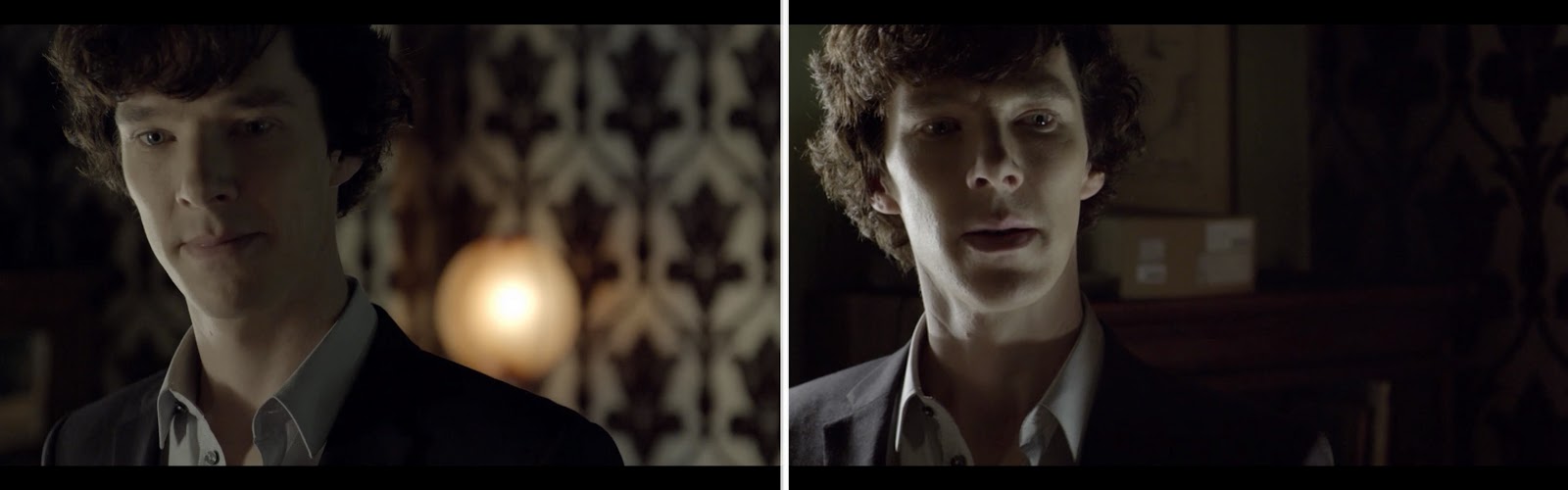
Additionally, though during this conversation we once again are brought close to Sherlock's face, lighting, composition, and body language strip this physical closeness of any intimacy.
left, Sherlock talking to John; right, Sherlock talking to Lestrade
lighting on the left is soft, bringing out his whole face, and the background is brightly lit; in contrast, the lighting on the right creates harsh shadows on his face, making it hard to see much of it, and the background is dark; of these two images, it's obvious which one is easier to relate to
Once Lestrade exits, we see Sherlock's energy release like a crossbow bolt, and he rapidly makes his way from the flat (or so we first are led to think). The moment he leaves, we are (or, at least, I am) struck by the stillness left in his wake. John is transformed in an instant from anchor to lead agent, and his brief exchange with Mrs. Hudson seems more banal than it otherwise would have been had it not so immediately followed Sherlock's exuberant departure. From John's demeanor, it seems as if he has much the same feeling.
the length of the kitchen in the background really helps to increase the sense of emptiness here; the fact that it's filled with Sherlock's stuff almost seems to suggest the cause of that emptiness
When Sherlock returns, so does his energy, albeit at a lower simmer, and as he walks back into the room, we can feel it begin to boil again. We know John feels it too because he gets to his feet (something he did not feel the need to do for Mrs. Hudson or Lestrade, though it's possible his decision to rise was also influenced by Mrs. Hudson's "rest your leg"). Sherlock's presence becomes intense very rapidly not only because of the leading nature of his questions, but because of how quickly he comes to fill the screen -- he is first shown in the doorway occupying about a fifth the screen, then moves to occupy almost half of John's screen space and over two thirds his own (the obstruction from John's head in fact serves to suggest a smaller screen space, and he fills all of it) within just a few seconds.
Sherlock, open again, though not necessarily relatable
Both John and the viewer are swept with him out the door because of the intensity of his energy, and the enormous, almost boundless freedom with which he moves through space, one of my favorite examples of which occurs directly following, when Sherlock swings almost like a pendulum from the doorway, to Mrs. Hudson, and back to and out through the door.
What's interesting here is that Sherlock has managed to charm both John and the viewer without offering anything solid with which we can connect. John follows because he's been caught in the hurricane, knowing next to nothing about the where and the why (which is a testament to the largeness of Sherlock's personality, given how many other people would be able to convince a relative stranger to go out with him and view a corpse?), and we want him to go with him, because we are equally as intrigued to know more of Sherlock Holmes and what exactly is making him so happy (in the hopes that maybe then we'll be able to understand him). It's not until John's been sitting in a cab with Sherlock until nightfall that the excitement wears off enough for him to bother to ask the most basic of questions: Who are you, and Where are we going?

Next time, I'll look at that scene, and hopefully get to Brixton, so I can move a bit faster through this episode.

Friday, April 26, 2013

Sherlock: "A Study in Pink" (Pt 1) - Setting & Theme Development


So I'll start this off by saying I really have no idea going in as to the structure I'm planning to attack this with. To be honest, I don't even know quite what I'm going to say, or, to be more precise, how I want to go about saying what I've noticed. I've taken a general class in cinematography, but I'm not by any stretch terribly knowledgeable on the subject of cameras. Further, while I've watched a fair bit of British film, I've not watched any of it critically, and besides Sherlock and a few episodes of Primeval and Doctor Who, I really know next to nothing about typical British cinematography -- if it differs from the usual American (US/Canadian) standards, though I don't really think it does much. That all being said, I've decided to go ahead with my plan of talking about Sherlock's cameras, because the reality is that Sherlock is easily the most stylish production I've ever watched. It's the only show that's consistently made me pause and rewind, just to see how a shot or composition was set up, and I can recall at least four separate scenes that I had to pause, just so I could take in the full impact of what just happened on my screen visually. I'm not going to make an argument about whether or not Sherlock is shot better -- that's far too judgy and subjective. I'm also not going to claim for a moment that its ideas are unique. I'm just going to try to impart my thoughts. And I'll say right off the bat, I'm sorry if anyone's done this before; I'm not in fandom, I haven't looked. This is all just personal gratification anyway.

Anyway, let's get started. I already said in my first post on this subject what I'm going to be looking at, generally, but I'll restate here, just to orient my thoughts. My first point of interest is how characters are framed, though I'm mainly going to stick with Sherlock and John (in future episodes, I'll likely also be talking about Moriarty and probably Irene Addler). I'll propose that the way they are shot heavily influences how they are perceived -- not only their moods, but how we are meant to relate to them. My second point will be made on the use of negative space, which will relate to my discussion on character perception (both in how characters move about the space given to them, and how they tend to be oriented within that space), but with the additional idea being to look at how all this extra space is used for transitions, as well as what I think I'll call "text exposition." My other points will have to do with general beauty in composition, and the cleverness with which the usual "rules" of cinematography are subverted, because I just want to recognize both. And since I'm breaking this up by episode, I'll have the space to do so.

With that out of the way, I'm finally going to actually get started, with "A Study in Pink."

Cameras and Characterization: Establishing Setting & First Impressions

I think it's fair to say that pretty much everyone came into this show with their own notions of who Sherlock Holmes and Dr. Watson are as characters (to be honest, I hope this is so, because I don't know that I want to conceptualize a world in which Sherlock is the only version of Sherlock Holmes people know about). That being said, initial character introductions were probably trickier than for other shows, because they couldn't simply have A Mysterious Though Obviously Central Figure walk into frame and then throughout the course of the scene, we as viewers find several qualities sympathetic and/or interesting enough to sew the initial seeds of investment. That wouldn't have flown. Most of us probably went in already knowing these characters at least somewhat intimately (for my part, I went in not liking either of them), and so these characters had to be immediately established in a way that would legitimize their source while distinguishing themselves from it. So how did they go about it?
our first view of John Watson
Likely, you form an opinion immediately upon viewing this still, which is precisely the point. I'll state what I see. We are looking down at John immediately after some sort of traumatic war memory. He is unhappy, and he is framed rather claustrophobically by virtue of the wall on the right and the edge of the very small mattress on the left. This all suggests he is trapped mentally, by virtue of his upset and the overall darkness of the scene, as well as physically, by virtue of how much he is being constrained by his environment. It is not surprising to see that he has a disability later on in the scene (or, it didn't surprise me), and I think this may be because of how his first few seconds are shot.
Further, we are immediately invited to sympathize with him. I saw the state of his stark, cheerless apartment, his weary posture, the look on his face, and I found myself already building a connection with him, because I felt sorry for him, and within moments I was looking forward to his eventual introduction to Sherlock, not just because I wanted to meet Sherlock, but because I wanted John to be saved from his situation. In this scene and the ones closely following, John is established as emotionally open through his relationship to the camera, and, consequently, the viewer.
open to the camera
note, warm colors
The way John is framed is actually fairly typical, in terms of what I've observed from other shows, which is probably what someone may say in response to these images. And I'd like to propose that that is exactly the point. John is framed in a familiar way because he's supposed to be familiar. He's the one who makes sense. None of this really comes into play until Sherlock finally makes his appearance.
our first view of Sherlock Holmes
note, cool colors
Once again, I'd imagine that anyone would take less than a moment to come to several opinions on viewing these stills. I know in my case, I was immediately disoriented by Sherlock's introduction. I'm not sure what I was expecting, but it certainly wasn't a tight close-up of his face, upside down. Sherlock's introduction is at utter contrast to John's -- we are the claustrophobic one, while Sherlock is clearly not. John's introduction casts the viewer as passive and sympathetic, but our first experience with Sherlock is that of being an object of study, a role which we are made to actively experience; he invades our space without warning or pretext. Immediately, we see Sherlock as someone in command of the situation, as someone bizarre and unpredictable. When the camera switches locations, we can still see him with his head in the bag. The tension and discomfort created by his initial framing are then dispelled, and the moment becomes comical, but we're still left with a lingering sense of confusion and disorientation. We look to Molly for some help in grounding Sherlock, but it's immediately clear that she doesn't have that capacity. And then we rapidly switch locations.
oh, poor, long-suffering Molly
Sherlock's first few scenes come in a whirlwind. The sense of his general weirdness grows. I knew what to expect from a Sherlock, but this one seemed partially insane. I rapidly came to see how funny yet unfunny he was, and the camera never seemed to stop in one place long enough for me to get my bearings. Just when I got used to him being in one place, he would invariably move.
note, Sherlock's orientation; he is on camera left, Molly on the right, but both are positioned in the same way; this means two things: a) this is not a typical conversation, because they are not facing each other, and b) Molly is positioned to be open to the camera (and, thus, sympathetic), while Sherlock is not
alone now, Sherlock is even less open than before, now partially obstructed by lab equipment
It's frankly a bit of a relief when he's finally still, but even then, he's no less enigmatic, and no more sympathetic. He simply doesn't position himself to be open to the camera. If one went in knowing nothing of Sherlock Holmes, one would be left feeling lost and confused about who this maniac is, and why he's whipping a corpse. Even knowing him, I was left feeling cut off from him, and I think that that was the point.
Sherlock is, for the first time, framed somewhat openly here, but within moments he moves again, as John is entering the scene; note John's sympathetic posture and positioning, pretty much open from the second he walks in
John enters, providing us an immediate harbor for grounding. Unlike Molly, he carries with him a measure of control, and the camera uses him as an anchor. Here again is the man we met before, the man who makes sense, and now his traits of normalcy and stability, as established in his introduction, seem heightened. John's presence doesn't necessarily help to unravel Sherlock, but he is able to act as our proxy. The bond that (in theory) began forming with him earlier now strengthens as John is thrown into an experience similar to the one we've just had -- having to grapple with the Great Confusion that is Sherlock.
John's stability and empathy comes, at least in part, from the fact that he doesn't move much in the scene. While Sherlock remains in almost constant motion, John simply stands there, calmly but suspiciously. Additionally, by consequence of his movement, Sherlock is shot from many directions, but John is not. This further cements our perception of John as stable and relatable, and Sherlock as eccentric and confusing.
note how much ground Sherlock is covering as John stands still
John, now alone, left to orient himself to what just occurred
Sherlock abruptly ends the scene by his exit, leaving John standing in the spot he's been occupying since his entrance. I would argue that the end of the scene (seen in the still above), that final image, is the most salient piece of the introduction of these characters, as it is the establishment of what will become a future motif of the show: John left standing in a space that Sherlock has recently abandoned (most heartrendingly, at the close of "Reichenbach") . Additionally, this final image continues to ask the viewer for her sympathy through its composition -- John is small, taking up only about a fifth of the frame, surrounded by a cold and alien landscape of lab equipment and chemicals, which he'd just previously judged as "a bit different from my day."

Initial Character Setting: Conclusion

Obviously, character establishment does not end with this scene. Equally important are the scenes following, but it's my opinion that the actual introduction was concluded here. I didn't expect my discussion of the introduction to run this long, so in the interest of reducing the final size of this particular post, I will stop here. In terms of synthesis, the most important difference between John and Sherlock is that John is always shot sympathetically, with openness to the camera and, thus, to the viewer. It's in him that we are invited to invest in and understand the story through, because he is presented as friendly, likeable, and relatable from the outset. This is important, because Sherlock is not shown to us as any of those things (*yet*). Rather, he is a curiosity, one whom we need more time with to understand; and, ultimately, we want to understand him, because we want to understand what it was we were just personally subjected to. I would argue that had our first view of Sherlock not been from within the body bag, had the viewer remained as passively observant as we were with John, Sherlock's inspiration for confusion and frustration wouldn't have been felt nearly to the same degree. These feelings lead to an increased feeling of solidarity with John, and so serve several purposes.

Next post, I will look at the first apartment scene, and how it affects that initial impression of Sherlock, and, hopefully, I will also look at a lot of other scenes, so that I don't end up talking about this episode for six posts.

Tuesday, April 23, 2013

Glass and spatial metaphors, or, Why I love Sherlock (BBC)

The nicest thing about a blog of this nature is that I can discuss any subject in as much detail and verbosity as I wish, which is not a freedom I enjoy elsewhere, and for this reason I find myself compelled to come here and spill my heart. At the moment, there is only one thing, in the depths of my soul, that I truly wish to discuss, and that is Sherlock (of the BBC).

I was once a member of fandom, though it was for a different show. After something like two or three years there, I left, and while I've visited others since (most notably, the Buffy and Castle fandoms), I've never been able to stay due to the experiences I tend to have in these generally eclectic (though oddly homogeneous) communities. My experience in fandom will likely be the subject of a different post, so I'll not focus on that here, but I figure I'd give some context as to why the analysis I'm about to give isn't being posted on some fan site (though to be perfectly frank, I can't imagine anyone is or will ever be reading this, so I'm not entirely sure why I feel compelled to explain).

Anyway, Sherlock. I'll admit I didn't love the show at first blush. I only vaguely appreciated it. I watched it at some point between the airing of s1 and s2, and I only made it through the first two episodes before deciding it wasn't holding my attention. It was interesting, but Sherlock as a character annoyed me, I found the plotting to be odd, and I absolutely could not buy some of the deductions. More to the point, at the time all I was looking for was another incarnation of the Woman, and a show with two male leads, one of whom could make House and Perry Cox look meek, just wasn't what I wanted. But somewhat recently I gave it another go, and now I see its genius. Not only that, but I can now see the Woman in Sherlock Holmes (not Irene Addler; the other Woman, the conception of her that I posited in my first post) quite clearly, and I cannot help but view him with an empathy that before I couldn't feel.

I'll save a discussion on Sherlock characterization for a later post, because while a fresh perspective on it was one thing that helped me to get into the show, that was by no means the thing that caught my attention, sucked me in, and now continues to cause me to rerun it and think about it. My obsession was founded in the cinematography and how the actors move through space. There is an extreme and subtle genius in it, and I find myself constantly finding something new to appreciate.
I could talk for ten minutes about this still, and I probably will...
Part of me is tempted to couch this discussion in some great comparative framework. It would be relatively simple for me to make my points on Sherlock by grabbing stills from other shows and saying something to the tune of "And this is why Sherlock does it better." But I've decided not to do that. I've also decided that I'm not going to generalize my discussion to the whole series. Since this is my blog, I'm going to go through each episode one-by-one, and I'm going to talk about the cameras and the acting and whatever else I feel like talking about. I simply have too much to say to be constrained to the big picture. But before doing that, I wanted to give a broader summary of my thoughts as they are now, just so I can provide an idea of what points I'm going to be making. This is probably the only part of my discussion that is going to be spoiler-free, so if anyone is reading, what lies below is safe if you haven't yet watched Sherlock (though if this is the case, two questions: why are you here, and why haven't you?).

First thought - The way the show is shot turns Sherlock into a character who is simultaneously empathetic and completely enigmatic. While he seems accessible, the viewer constantly will find herself at arm's length from him, never truly meeting him at his level. The viewer is effectively put into John's shoes without her ever actually directly occupying them. I will end up spending a lot of time on this point, so I'm not going to expound much on that here, but the main thing I want to suggest is that this is as a result of cinematic decisions mainly. I will not deny the importance of the performance and the writing, because certainly BC's acting is a large part of what sells it, but I will argue that its his relationship with the camera, rather than with the words, that makes his role so interesting. I will end up making a similar case when talking about John Watson, and his relationship with Sherlock, as well as other characters.
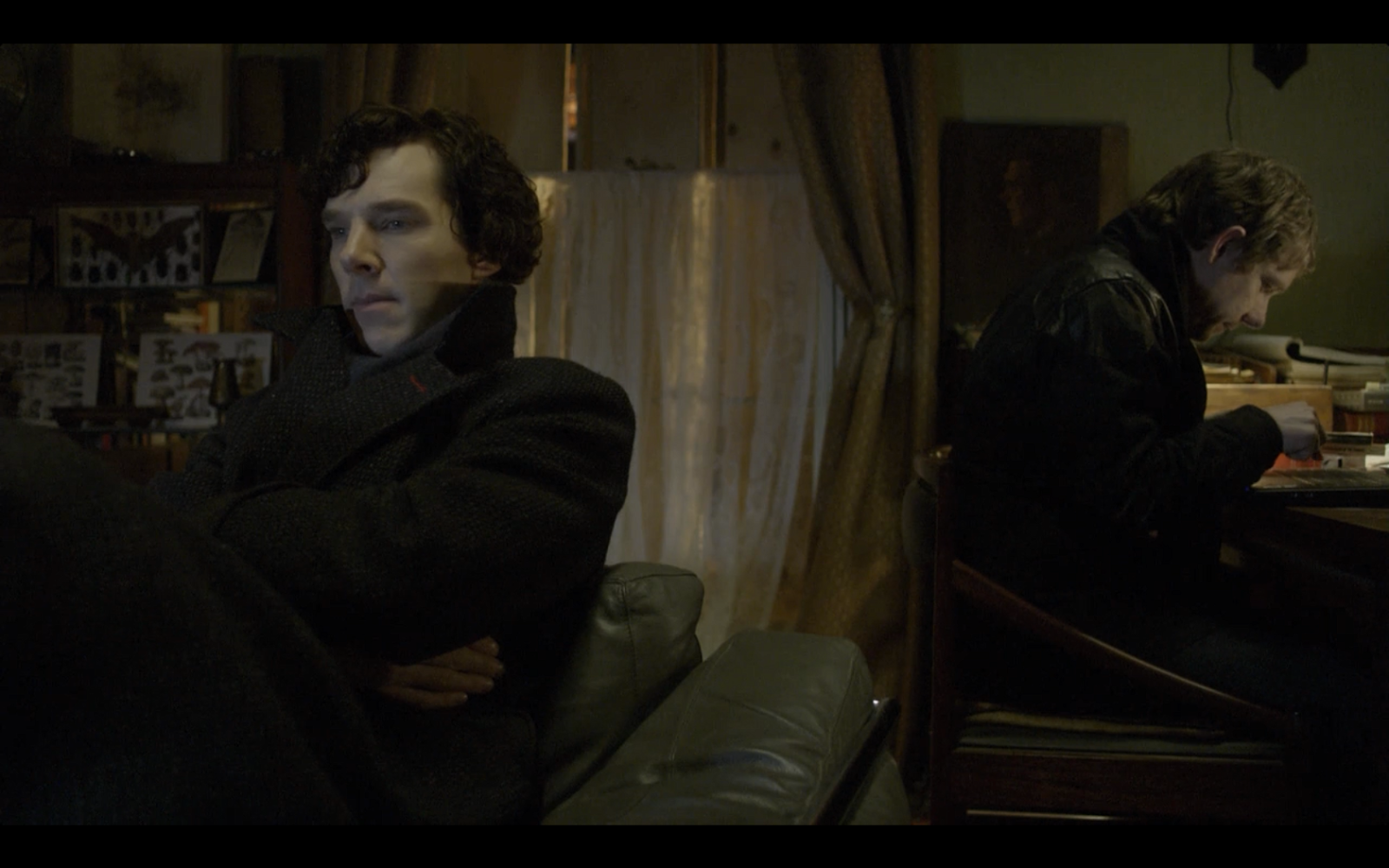
this still says more than simply how sexy that coat is
Second thought - The show makes excellent (and constant) use of negative space. Anyone who's watched the show will probably think immediately of how text is projected on blank space on walls and in the air, and while negative space is often employed for this purpose, that is by no means its only use. Negative space is often used to spatially literalize the distance between characters, and its use as a metaphoric device truly deserves some attention and recognition.
negative space here, used for several purposes
Third thought - Extending off that point, Sherlock utilizes metaphors in its camerawork in more ways than just its use of negative space. One of the more obvious is scenes shot through glass, like windows and doors, as well as the use of mirrors and other reflective surfaces. While this cinematic device is nothing new to film, I would nonetheless like to talk about how clever its employment often is, and why it deserves to be discussed. There are other metaphors I saw expressed through scene composition, but I will save specific examples for later posts.
ultimately, this is more than just artful composition
I have other thoughts, many of which have to do with how clever I find the cinematography to be in more of a general sense, but I will not spend the time to list them all here, given that they center around one scene or one episode.

And so that is the game plan. I look forward to talking about this, perhaps in greater detail than anyone cares about, because I cannot bear to not talk about Sherlock for any longer. Distance from fandom does indeed have its disadvantages... But, at any rate, onward, to "A Study in Pink."