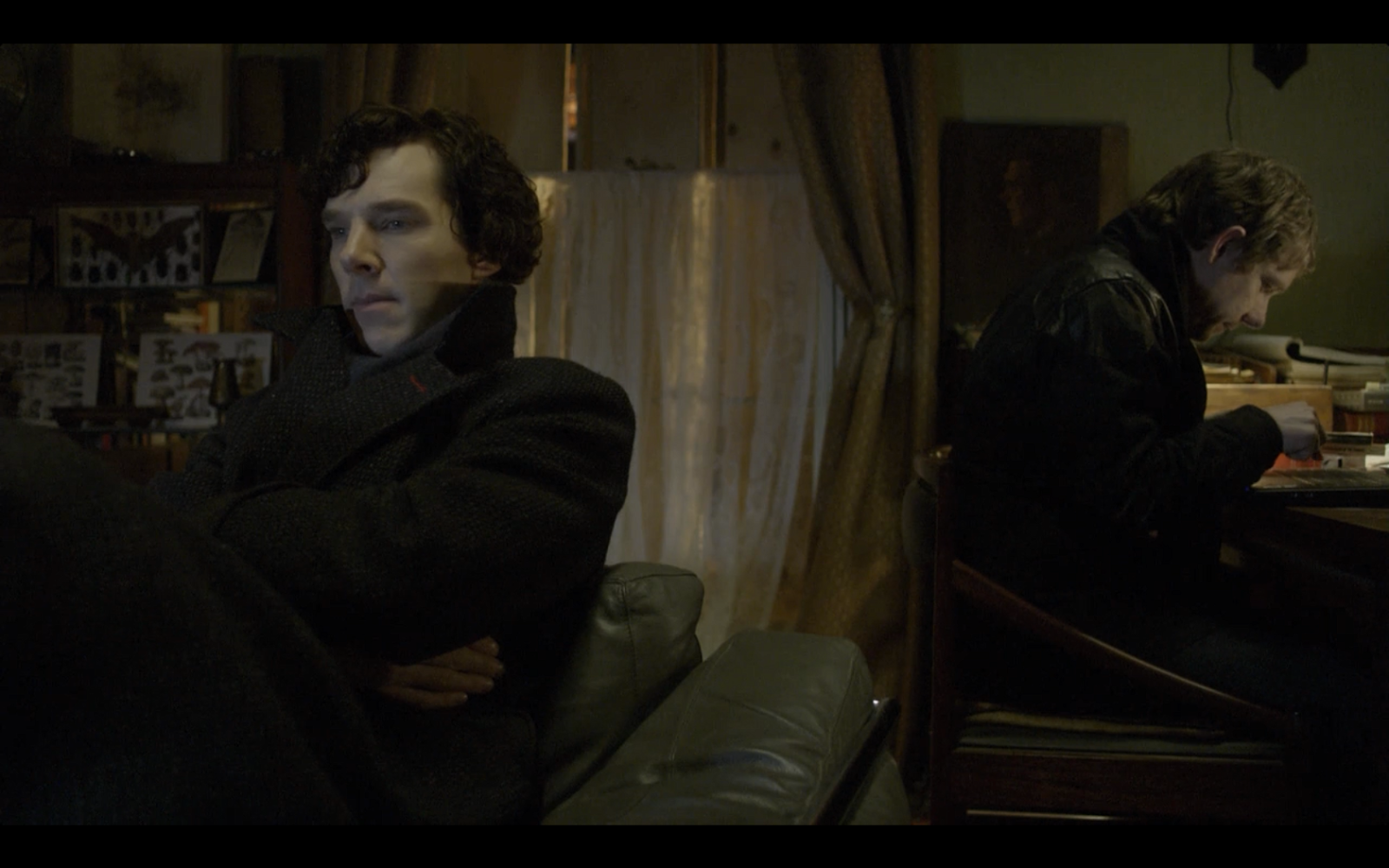
(this post is mostly spoiler-free; just some vague generalizations of character arcs)
If it wasn't already immediately, startlingly clear, I spend a lot of time thinking about characters and characterization. I do it almost exclusively for television shows, and then only for select characters, and when I look back on the ones I'm both drawn toward and do the most thinking about, it seems that I can draw one common line between all of them: they've suffered a lot, both in their backstory and a decent portion of their screentime.
I used to think this meant I was a horrible person, that I was some sort of closet sociopath using fictional characters as a proxy for squirrels and small animals. It didn't help that on fan communities, I seemed to be in the high minority, obsessed with the dark and the melancholy, continually dragging my most favorite characters through live coals as everyone else discussed UST and their theories for how and where and why the leads would finally get together (and how many times). At first I pretended to live in the shipper camp, but I rapidly ended up dropping all pretense, finding myself annoyed at how flat and domestic and boring my favorite characters were in those contexts. I never could (and still can't) figure out the appeal of turning canonically strong, independent, workaholic women into pregnant mothers who've quit their jobs to move to a suburb and advise their ironically named daughters on teen crushes while still managing to have vast amounts of sex with their OTP partner at every viable opportunity. To this day, I wonder why people like this watch the same shows I watch when, clearly, all they really want to be watching is a mash-up of General Hospital and The Brady Bunch.
I don't necessarily want to make the claim that my perception of characters is the only valid one, that the enjoyment that shippers and fannits take from shows is any less than what I get. I have the same tendency to reduce characters to the roles I find most engaging, and while I may have convinced myself that my interpretations are true to character, I can't deny that I will always decide to have my leads haunted by memories both fresh and long scabbed over, that I will see them in isolation, spiraling down a path of self-destruction and reckless disregard. But I at least have an excuse -- I specifically seek out characters who are prone to this sort of behavior. It's for this reason that it disturbs me all the more when I see them slutshamed, flattened into the role of housewife and mother, and made apathetic toward both their destiny and their past. I've found this activity in every fandom I've ever visited, no matter how brief the duration of my visit, and this is the primary reason I now avoid it to the best of my ability, despite how desperately I wish I could participate. What sucks the most about my self-imposed isolation is that I'm sure there are plenty of fans who are like me, but I'll never find them because they don't coalesce, because they're all avoiding fandom for the same reasons I am.
At any rate, I'll lay my opinions on fandom to rest (for the moment, anyway). I'm more interested in discussing why suffering can be, to me, the purest, bluest meth of narrative devices.
I'll first say that it's not necessarily the suffering itself, that my focus isn't on the event which brought about misery. I still can't watch episodes like "The Body" and "Seeing Red" (Buffy) or "Momento Mori" and "Redux" (X-Files) more than maybe once a year. While the event itself is important, I don't necessarily enjoy revisiting it, because while I enjoy my character writhing in a state of agony and anguish, I don't like seeing them in that much pain, at least not regularly.
Additionally, it's not just suffering for the sake of suffering. This is why I've never invested with characters in post-apocalyptic situations (in movies, books, or television), and this is why while I'll watch Walking Dead, I'll never connect with it. I have the same opinion of Breaking Bad -- I watch and enjoy it, but the suffering in that show doesn't speak to me or cause me to think about it. It's not that I couldn't over-analyze the hell out of it, since the characters are more than fleshed out enough; I just have no desire to do so. I considered the possibility that it's because I don't connect to shows which lack strong female presence, but I find it ridiculously easy to kill several hours turning Sherlock over and over, so that theory is out. It's not the "gritty" nature of the shows either. I always tend to think of characters under bleak lights anyway. It's also not because I refuse to connect with characters who don't have Plot Armor. If that were the case, I wouldn't like Game of Thrones (though, I don't spend any time angsting over that series' characters either, or, at least, I stopped doing so by the end of book 2, because there was zero point), or anything Joss Whedon* does (why, Joss, whyyyyyyy?). So what then?
The answer becomes clearer when I think about my top five list, the criteria for which are fairly simple: spent an uncountable amount of hours sitting around thinking about the minutia of these characters lives, before, between, and after canon; at least attempted exploratory fiction on these characters' backstories; sought fanfiction specifically oriented toward fleshing out these characters (with varying success); bothered to angst over their position on the list; and wondered at their cooperative role in the zombie apocalypse (since, as I stated previously, this list doubles as my Zombie Apocalypse Dream Team). There are other characters I've done this for, but none to the degree of these five, which is what's earned them their (fairly cemented) positions.
1. Buffy Summers (Buffy the Vampire Slayer) - I don't even know how to begin to approach my love for Buffy. I don't even think I can. What I can say is she's by far the most complex, interesting character I've ever had the utmost pleasure of considering, both in her own context and her relationship with other characters. I can never spare enough thoughts for her, can never watch an episode without folding it into her greater arc. The depths of her grief and the heights of her triumphs are unparalleled. If Buffy was the only show I could watch for the rest of my life, I'd die satisfied anyway.
BONUS: If you want to read the best post-series fic I've ever seen, with some of the best prose and plot I've come across in fanfiction, then I am happy to share Clocks of the Long Now with you. Read first, thank me later. Lostboy also has excellent Buffy analysis on his journal, so read those too.
2. Jordan Cavanaugh (Crossing Jordan) - Oh, Jordan. Jordan is just an unapologetic, passionate, self-destructive force. It's true that she mellows out after s2, but never entirely. Her occasional bouts of moral ambiguity coupled with her overwhelming instinct to distrust the people who love her most never fails to suck me in just as helplessly as everyone around her. Her relationship with Garret Macy is somewhat analogous to Buffy/Giles, which only helps to draw me back continually for rerun. And while she doesn't live in a state of near constant suffering, as Buffy does, her life is certainly ruled, at times, by great darkness and melancholy, which she faces with almost no grace whatsoever. Half the time, she only smiles when she's sad and would rather no one know it. In considering her over the series, it amazes me how effectively she was able to hide the great majority of her adventures (or, at the least, the extent of them) from her closest friends.
Jordan is an inspiration for self-destructive loners everywhere.
3. Balsa the Spearwielder (Moribito: Guardian of the Spirit) - What? Who the hell is this? An anime character? In front of Beckett? Why? Well, I'll tell you why. Because she's awesome.
I'm not really an anime fan. There were a couple years I delved into a few (mostly Bleach and Cowboy Bebop, the latter of which is legit good programming, no joke), but the look of that style of animation never really appealed to me, and neither did the characters that tended to repeat themselves (not even mentioning the plots, ugh). But Moribito is the true exception. I even bought the discs. Like Cowboy Bebop, the animation style has a lot of flow and movement in it, and the combat is extremely fun and visceral, which helped to sell it initially, but, honestly, even if it was as ugly as Inuyasha, I'd have loved it for Balsa.
Balsa is endlessly interesting to consider, just in terms of the life she's chosen to lead and the sorts of choices she makes on the show. She's a lone warrior type, someone who travels between countries without any real sense of provenience, and while she states explicitly that her life is dictated by her desire to balance a moral scale set askew in her backstory, it becomes clear on even cursory examination that her standards for morality and humanity are not the same which motivate characters like Beckett. Further, her decision to become a bodyguard may have been influenced by her deep feelings of responsibility over the losses in her past, but it's clear that to some degree she just does it because she likes it, and we know this because of the tone of her relationship with Tanda and the conversations they have. I've always been a sucker for lone warrior characters, but what sets her apart for me is that the end of her canonical story is not the end of her wandering, and we're left with the heavy suggestion that she likely will never stop to settle, and will instead die on the road. Her world is lonely, grim, and bloody, but it's a world she chooses to remain in, despite how much other characters express their wish for her to remain with them. The story of the show almost suggests to the viewer, and to her, that she really could settle down, that she really could learn to lose her wanderlust, but then she doesn't, and the fact that she's able to do this makes her so, ridiculously interesting to me.
I just love her. I want Balsa and Geralt of Rivia to have a long, torrid romance, and then I want them to join forces in their mission to protect the world's weary travelers for coin.
4. Kate Beckett (Castle) - I admit, it's weird putting Beckett below Balsa. I'll say that had she acted differently in "Recoil," she would've jumped the list and claimed slot three, no question. I accept the fact that she's someone who places a lot of importance in her morals, who doesn't want to become just as bad as the people who've ruined her life (not becoming a monster in the process of fighting them, as it were), and while that's a mindset that's commendable, I have a lot more fun with characters who are less concerned with retaining their humanity (Jordan, Balsa), or who've long since given up on the possibility of retaining it despite extended internal struggle (Buffy). The few times when she's let the rein slip on her iron, vice-like grip over her impulses are the times I've been so into the show that at that moment, if an armed gang broke into my apartment, I probably would not have noticed.
Beckett appeals to me with her bravery and staunch resoluteness, with the fact that despite heavy pain in her recent and distant past, she still manages to remain mostly unbroken. She easily could be Jordan, who is arguably her (preceding) shadow, but she instead chooses to meet the world with a relatively easy heart. How much of this is because Castle helps to offset her burden, I'm not entirely sure (Montgomery does suggest she was far less happy prior to Castle's...invasion), but the key is that she allows him to offset it at all. Despite the closeness between Jordan and Garret, Jordan rarely confides in him openly, instead choosing to obfuscate, admitting her pain without allowing a window to its source (this is best seen in 4.3, "Intruded;" so beautiful was her obfuscation, I honestly didn't even notice what she was doing until my third or fourth rewatch). Castle accuses Beckett of not wanting to heal, of hiding away in and defining herself by her past, but the reality is that compared to Jordan and Balsa, Beckett does make a real effort to keep herself firmly above water. This is part of what makes Beckett so interesting to me, but also what makes her slightly less fun, because, ultimately, I love a good loose cannon (and, god, as the only representative from an extant show on this list, may she have the opportunity to become one; there's still time).
5. Dana Scully (if you don't know which show, I am ashamed for and of you) - I feel like a terrible person for putting her last on any list, because there are few characters who can fill me with such a sense of warmth and affection, but I guess the reality is that as much as I love her, her pain makes me more sad than it does endlessly intrigued. The thing about Scully is that she's like the rest of the characters on this list, in that she's a victim of external circumstance which forever shattered who she was and who she would have been prior to this event. But I think one of the differences is that the other four chose to become defined by their tragedies. All four of them could have let it go, but they did not. Scully is different in that she accepts her tragedies but does not become driven by them (as Mulder does). Her arc after "Duane Barry" doesn't see her transformed into one haunted by the horrors inflicted on her, even when they manifest in the most nightmarish way imaginable in s4. Her pain is marked by how little she acknowledges it, and how quietly (if angrily) she faces it. The grace with which she copes with her life, with the degradation of the career she worked so hard to build, with the loneliness that quickly came to smother her life after she met Mulder, makes her seem almost saintly. Seeing her finally crack, as in "Never Again," "Redux," "Triangle," and "Orison" (though the cause of the breaks in these episodes are different) hits with the force of a shotgun blast, because it's almost shocking to see the depths of her pain and her passion when, for just a moment, she lets the mask slip.
BONUS: BeshterAngelus on FF.net tackled the most ambitious fanfic project I've ever seen: writing the whole of X-Files through Scully's perspective. To be clear, she's not rewriting episodes; she's writing between-scenes, turning the whole of the series into one extremely long, cohesive story (a feat I wouldn't think possible, given how little the mytharc makes sense, but BeshterAngelus achieves it). All of it is completely in character, and it really helped me to understand Scully outside her shield of professionalism, without being in Mulder's shadow, as well as to understand the evolution of her arc, from the green feebie we meet in s1 to the hardened, world-weary veteran we see by s6. It's long, it's great, and if you like the show, it will probably deepen your understanding of it, as it did mine.
So just read it. Clear your calendar. Start at Season One. But read Clocks first, because Clocks is just amazing.
At any rate, I've now given my favorite characters, with at least a partial description as to why they've made the list. I think just from my description, it might already be starting to become clear what it is about suffering that triggers my addiction. But I'll expound anyway, because that's what this blog is for.
Suffering leads to two things (well, more than that, but I'm focusing on two), if written correctly: it can apply an intense amount of depth and complexity to characters, warping their moral fortitude and how they choose to build and interact within relationships. It can lead to unpredictability, to great internal and external violence (toward themselves, toward enemies, and toward allies). But it can also lead to great strength and courage, to a bravery that is not, as Mycroft Holmes so cynically put it, a form of stupidity. Their struggle to retain their humanity and to keep their core selves whole and unsplintered is something I find endlessly fascinating to watch and consider, especially when morals formed in daylight are thrown against the sharpness of personal tragedy and threats of violence against either themselves or their loved ones. Those moments define who these characters are, who they perceive themselves to be, what role they truly occupy in the morality play of their lives. Sherlock tells John that heroes don't exist, and that if they did, he wouldn't be one, yet we see the extent of his sacrifice in "Reichenbach." Buffy in "The Gift" makes her threat to the Scoobies, yet we see what she does for Ben, and what action she takes upon reaching the top of the tower. Beckett seems to be on the edge of finally throwing away her moral convictions, and yet we see what she does in "After the Storm" and "Recoil." I could go on.
The point I'm making is that suffering and struggle as a plot device help to clearly define these characters against a high contrast backdrop as it's painted through desperate circumstance. They become flag bearers for qualities like zeal, courage, grit, fortitude, loyalty, and rightness, things which are so rarely important in middle class, Western life. They become heroes, sometimes role models, occasionally ideals, just as they can serve as a commentary on the consequences of leading too solitary and private a life. In my case, characters like Buffy and Beckett in some way reinstate my faith in humanity, because just for a moment they can make me believe in the strength the human will is capable of achieving.
Great suffering in one character also leads to the evolution of their foil character -- Beckett changes Castle, Jordan changes Garret (and Max), Balsa changes Tanda, Scully and Mulder change each other (though Scully is arguably Mulder's foil for a good portion of the series), Buffy changes everyone. Usually the foil won't have led a life of great suffering; for the most part, they will occupy the role of Normal, Everyday Guy, which makes them (at least to me) decidedly less interesting to think about. I'm fully able to psychoanalyze Castle, to figure out his backstory and how he ended up the man he is, but the story I've seen in him isn't one of great trial. He doesn't become interesting until he steps from the world of normal people with normal lives into Beckett's world, one which is filled with moral ambiguity and ugly people and desperate choices. Scully too is far less interesting before she moves into the basement office and Mulder's life, when suddenly the world and the rules she knew before have mostly lost their relevancy.
And this is why suffering, and at that, neverending, increasingly, pressingly, desperate amounts of it, as a plot device have so enthralled me that at times I've completely lost myself to these characters' stories, forgetting homework and dinner and the need for sleep and the fact that the world is a thing that exists that goes around the sun. Because I want to be Castle, or Scully, or Tanda, or Garret, to step into a more desperate world, where the colors are far brighter and the decisions far less trivial. Because, since I can never become Buffy, I'd like to just get as close to her as physically possible, so I may see the world as she does. So I may see truth and love and passion and loyalty, naked, pure, and uncomplicated, and maybe find its taste myself.
* I mention Joss Whedon a lot as if he's the sole author of his shows; I realize he's not the whole of his work, and I greatly respect and acknowledge the part writers like Marti Noxon, Jane Espenson, Doug Petrie, David Fury, Maurrissa Tancharoen etc. contributed to his shows, but I obviously can't list everyone involved every time I mention a Whedon show.
Additionally, it's not just suffering for the sake of suffering. This is why I've never invested with characters in post-apocalyptic situations (in movies, books, or television), and this is why while I'll watch Walking Dead, I'll never connect with it. I have the same opinion of Breaking Bad -- I watch and enjoy it, but the suffering in that show doesn't speak to me or cause me to think about it. It's not that I couldn't over-analyze the hell out of it, since the characters are more than fleshed out enough; I just have no desire to do so. I considered the possibility that it's because I don't connect to shows which lack strong female presence, but I find it ridiculously easy to kill several hours turning Sherlock over and over, so that theory is out. It's not the "gritty" nature of the shows either. I always tend to think of characters under bleak lights anyway. It's also not because I refuse to connect with characters who don't have Plot Armor. If that were the case, I wouldn't like Game of Thrones (though, I don't spend any time angsting over that series' characters either, or, at least, I stopped doing so by the end of book 2, because there was zero point), or anything Joss Whedon* does (why, Joss, whyyyyyyy?). So what then?
The answer becomes clearer when I think about my top five list, the criteria for which are fairly simple: spent an uncountable amount of hours sitting around thinking about the minutia of these characters lives, before, between, and after canon; at least attempted exploratory fiction on these characters' backstories; sought fanfiction specifically oriented toward fleshing out these characters (with varying success); bothered to angst over their position on the list; and wondered at their cooperative role in the zombie apocalypse (since, as I stated previously, this list doubles as my Zombie Apocalypse Dream Team). There are other characters I've done this for, but none to the degree of these five, which is what's earned them their (fairly cemented) positions.
1. Buffy Summers (Buffy the Vampire Slayer) - I don't even know how to begin to approach my love for Buffy. I don't even think I can. What I can say is she's by far the most complex, interesting character I've ever had the utmost pleasure of considering, both in her own context and her relationship with other characters. I can never spare enough thoughts for her, can never watch an episode without folding it into her greater arc. The depths of her grief and the heights of her triumphs are unparalleled. If Buffy was the only show I could watch for the rest of my life, I'd die satisfied anyway.
BONUS: If you want to read the best post-series fic I've ever seen, with some of the best prose and plot I've come across in fanfiction, then I am happy to share Clocks of the Long Now with you. Read first, thank me later. Lostboy also has excellent Buffy analysis on his journal, so read those too.
2. Jordan Cavanaugh (Crossing Jordan) - Oh, Jordan. Jordan is just an unapologetic, passionate, self-destructive force. It's true that she mellows out after s2, but never entirely. Her occasional bouts of moral ambiguity coupled with her overwhelming instinct to distrust the people who love her most never fails to suck me in just as helplessly as everyone around her. Her relationship with Garret Macy is somewhat analogous to Buffy/Giles, which only helps to draw me back continually for rerun. And while she doesn't live in a state of near constant suffering, as Buffy does, her life is certainly ruled, at times, by great darkness and melancholy, which she faces with almost no grace whatsoever. Half the time, she only smiles when she's sad and would rather no one know it. In considering her over the series, it amazes me how effectively she was able to hide the great majority of her adventures (or, at the least, the extent of them) from her closest friends.
Jordan is an inspiration for self-destructive loners everywhere.
3. Balsa the Spearwielder (Moribito: Guardian of the Spirit) - What? Who the hell is this? An anime character? In front of Beckett? Why? Well, I'll tell you why. Because she's awesome.
I'm not really an anime fan. There were a couple years I delved into a few (mostly Bleach and Cowboy Bebop, the latter of which is legit good programming, no joke), but the look of that style of animation never really appealed to me, and neither did the characters that tended to repeat themselves (not even mentioning the plots, ugh). But Moribito is the true exception. I even bought the discs. Like Cowboy Bebop, the animation style has a lot of flow and movement in it, and the combat is extremely fun and visceral, which helped to sell it initially, but, honestly, even if it was as ugly as Inuyasha, I'd have loved it for Balsa.
Balsa is endlessly interesting to consider, just in terms of the life she's chosen to lead and the sorts of choices she makes on the show. She's a lone warrior type, someone who travels between countries without any real sense of provenience, and while she states explicitly that her life is dictated by her desire to balance a moral scale set askew in her backstory, it becomes clear on even cursory examination that her standards for morality and humanity are not the same which motivate characters like Beckett. Further, her decision to become a bodyguard may have been influenced by her deep feelings of responsibility over the losses in her past, but it's clear that to some degree she just does it because she likes it, and we know this because of the tone of her relationship with Tanda and the conversations they have. I've always been a sucker for lone warrior characters, but what sets her apart for me is that the end of her canonical story is not the end of her wandering, and we're left with the heavy suggestion that she likely will never stop to settle, and will instead die on the road. Her world is lonely, grim, and bloody, but it's a world she chooses to remain in, despite how much other characters express their wish for her to remain with them. The story of the show almost suggests to the viewer, and to her, that she really could settle down, that she really could learn to lose her wanderlust, but then she doesn't, and the fact that she's able to do this makes her so, ridiculously interesting to me.
I just love her. I want Balsa and Geralt of Rivia to have a long, torrid romance, and then I want them to join forces in their mission to protect the world's weary travelers for coin.
4. Kate Beckett (Castle) - I admit, it's weird putting Beckett below Balsa. I'll say that had she acted differently in "Recoil," she would've jumped the list and claimed slot three, no question. I accept the fact that she's someone who places a lot of importance in her morals, who doesn't want to become just as bad as the people who've ruined her life (not becoming a monster in the process of fighting them, as it were), and while that's a mindset that's commendable, I have a lot more fun with characters who are less concerned with retaining their humanity (Jordan, Balsa), or who've long since given up on the possibility of retaining it despite extended internal struggle (Buffy). The few times when she's let the rein slip on her iron, vice-like grip over her impulses are the times I've been so into the show that at that moment, if an armed gang broke into my apartment, I probably would not have noticed.
Beckett appeals to me with her bravery and staunch resoluteness, with the fact that despite heavy pain in her recent and distant past, she still manages to remain mostly unbroken. She easily could be Jordan, who is arguably her (preceding) shadow, but she instead chooses to meet the world with a relatively easy heart. How much of this is because Castle helps to offset her burden, I'm not entirely sure (Montgomery does suggest she was far less happy prior to Castle's...invasion), but the key is that she allows him to offset it at all. Despite the closeness between Jordan and Garret, Jordan rarely confides in him openly, instead choosing to obfuscate, admitting her pain without allowing a window to its source (this is best seen in 4.3, "Intruded;" so beautiful was her obfuscation, I honestly didn't even notice what she was doing until my third or fourth rewatch). Castle accuses Beckett of not wanting to heal, of hiding away in and defining herself by her past, but the reality is that compared to Jordan and Balsa, Beckett does make a real effort to keep herself firmly above water. This is part of what makes Beckett so interesting to me, but also what makes her slightly less fun, because, ultimately, I love a good loose cannon (and, god, as the only representative from an extant show on this list, may she have the opportunity to become one; there's still time).
5. Dana Scully (if you don't know which show, I am ashamed for and of you) - I feel like a terrible person for putting her last on any list, because there are few characters who can fill me with such a sense of warmth and affection, but I guess the reality is that as much as I love her, her pain makes me more sad than it does endlessly intrigued. The thing about Scully is that she's like the rest of the characters on this list, in that she's a victim of external circumstance which forever shattered who she was and who she would have been prior to this event. But I think one of the differences is that the other four chose to become defined by their tragedies. All four of them could have let it go, but they did not. Scully is different in that she accepts her tragedies but does not become driven by them (as Mulder does). Her arc after "Duane Barry" doesn't see her transformed into one haunted by the horrors inflicted on her, even when they manifest in the most nightmarish way imaginable in s4. Her pain is marked by how little she acknowledges it, and how quietly (if angrily) she faces it. The grace with which she copes with her life, with the degradation of the career she worked so hard to build, with the loneliness that quickly came to smother her life after she met Mulder, makes her seem almost saintly. Seeing her finally crack, as in "Never Again," "Redux," "Triangle," and "Orison" (though the cause of the breaks in these episodes are different) hits with the force of a shotgun blast, because it's almost shocking to see the depths of her pain and her passion when, for just a moment, she lets the mask slip.
BONUS: BeshterAngelus on FF.net tackled the most ambitious fanfic project I've ever seen: writing the whole of X-Files through Scully's perspective. To be clear, she's not rewriting episodes; she's writing between-scenes, turning the whole of the series into one extremely long, cohesive story (a feat I wouldn't think possible, given how little the mytharc makes sense, but BeshterAngelus achieves it). All of it is completely in character, and it really helped me to understand Scully outside her shield of professionalism, without being in Mulder's shadow, as well as to understand the evolution of her arc, from the green feebie we meet in s1 to the hardened, world-weary veteran we see by s6. It's long, it's great, and if you like the show, it will probably deepen your understanding of it, as it did mine.
So just read it. Clear your calendar. Start at Season One. But read Clocks first, because Clocks is just amazing.
--
Suffering leads to two things (well, more than that, but I'm focusing on two), if written correctly: it can apply an intense amount of depth and complexity to characters, warping their moral fortitude and how they choose to build and interact within relationships. It can lead to unpredictability, to great internal and external violence (toward themselves, toward enemies, and toward allies). But it can also lead to great strength and courage, to a bravery that is not, as Mycroft Holmes so cynically put it, a form of stupidity. Their struggle to retain their humanity and to keep their core selves whole and unsplintered is something I find endlessly fascinating to watch and consider, especially when morals formed in daylight are thrown against the sharpness of personal tragedy and threats of violence against either themselves or their loved ones. Those moments define who these characters are, who they perceive themselves to be, what role they truly occupy in the morality play of their lives. Sherlock tells John that heroes don't exist, and that if they did, he wouldn't be one, yet we see the extent of his sacrifice in "Reichenbach." Buffy in "The Gift" makes her threat to the Scoobies, yet we see what she does for Ben, and what action she takes upon reaching the top of the tower. Beckett seems to be on the edge of finally throwing away her moral convictions, and yet we see what she does in "After the Storm" and "Recoil." I could go on.
The point I'm making is that suffering and struggle as a plot device help to clearly define these characters against a high contrast backdrop as it's painted through desperate circumstance. They become flag bearers for qualities like zeal, courage, grit, fortitude, loyalty, and rightness, things which are so rarely important in middle class, Western life. They become heroes, sometimes role models, occasionally ideals, just as they can serve as a commentary on the consequences of leading too solitary and private a life. In my case, characters like Buffy and Beckett in some way reinstate my faith in humanity, because just for a moment they can make me believe in the strength the human will is capable of achieving.
Great suffering in one character also leads to the evolution of their foil character -- Beckett changes Castle, Jordan changes Garret (and Max), Balsa changes Tanda, Scully and Mulder change each other (though Scully is arguably Mulder's foil for a good portion of the series), Buffy changes everyone. Usually the foil won't have led a life of great suffering; for the most part, they will occupy the role of Normal, Everyday Guy, which makes them (at least to me) decidedly less interesting to think about. I'm fully able to psychoanalyze Castle, to figure out his backstory and how he ended up the man he is, but the story I've seen in him isn't one of great trial. He doesn't become interesting until he steps from the world of normal people with normal lives into Beckett's world, one which is filled with moral ambiguity and ugly people and desperate choices. Scully too is far less interesting before she moves into the basement office and Mulder's life, when suddenly the world and the rules she knew before have mostly lost their relevancy.
And this is why suffering, and at that, neverending, increasingly, pressingly, desperate amounts of it, as a plot device have so enthralled me that at times I've completely lost myself to these characters' stories, forgetting homework and dinner and the need for sleep and the fact that the world is a thing that exists that goes around the sun. Because I want to be Castle, or Scully, or Tanda, or Garret, to step into a more desperate world, where the colors are far brighter and the decisions far less trivial. Because, since I can never become Buffy, I'd like to just get as close to her as physically possible, so I may see the world as she does. So I may see truth and love and passion and loyalty, naked, pure, and uncomplicated, and maybe find its taste myself.
* I mention Joss Whedon a lot as if he's the sole author of his shows; I realize he's not the whole of his work, and I greatly respect and acknowledge the part writers like Marti Noxon, Jane Espenson, Doug Petrie, David Fury, Maurrissa Tancharoen etc. contributed to his shows, but I obviously can't list everyone involved every time I mention a Whedon show.